
The Roadster returns, Privé turns 10, and the Myst goes full jewelry. Everything Cartier released at Watches & Wonders 2026.

No house at Watches & Wonders is operating across as many lanes as Cartier. Six key releases, each aimed at a different register: a revived sports watch, a sculptural jewelry piece, a quiet but meaningful bracelet update, a métiers d’art showpiece, a collector-focused reissue program, and a case shape that continues to evolve more than a century after it was first drawn. Taken individually, each one makes sense. Together, they outline something more deliberate. Cartier isn’t trying to dominate a single category, and is instead operating across all of them at once.
What This Year's Novelties Add Up To
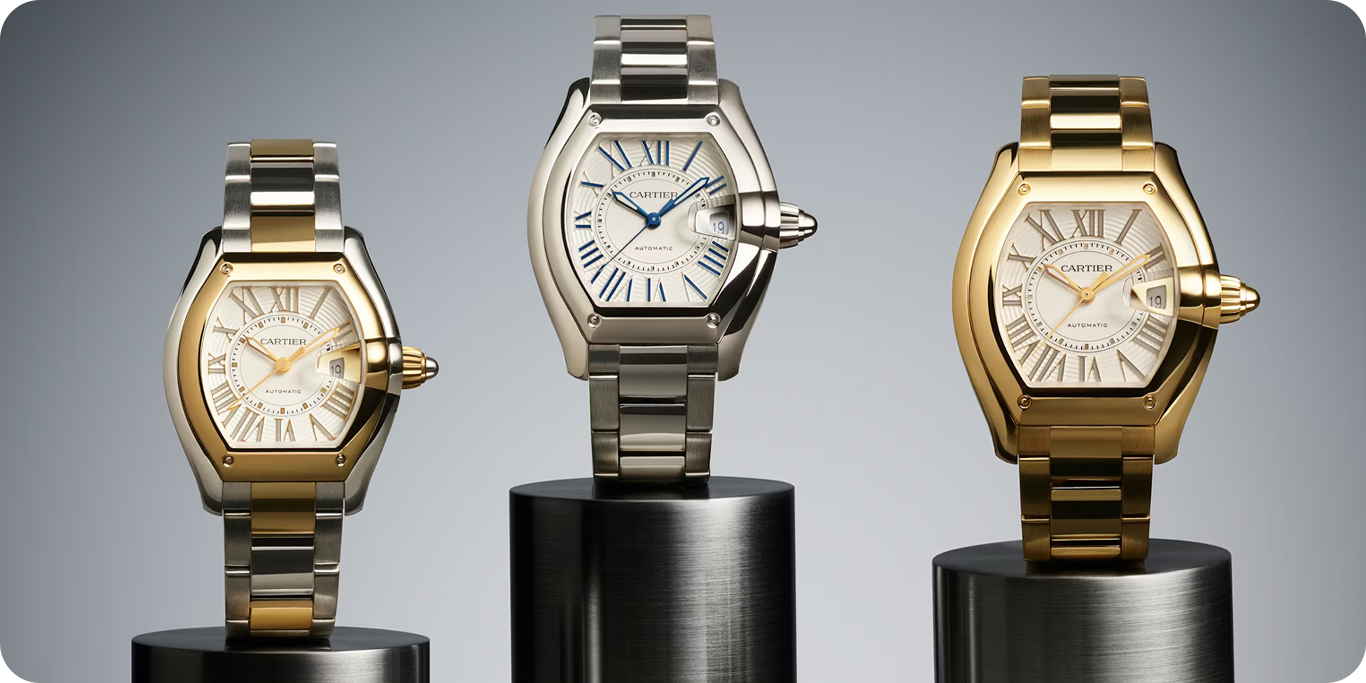
Cartier is reviving the Roadster, the automotive-inspired watch that ran from 2001 to 2012, and the new version keeps the core of what made the original recognizable. The tonneau-shaped case, the dial built around concentric rings, the magnified date that reads more like a headlight than a traditional cyclops, the integrated crown with its conical profile, all still here. What has changed is proportion. The case is cleaner, the lines feel more controlled, and the bracelet has been reworked with a QuickSwitch system that makes it easier to move between bracelet, alligator, and rubber.
The update is measured rather than transformative. The watch wears more easily than before, which matters, but some of the earlier Roadster’s idiosyncrasies have been smoothed out in the process. That trade-off will land differently depending on how much you valued the original’s slightly awkward charm. Cartier has made the watch more usable. Whether it has made it more interesting is less clear.
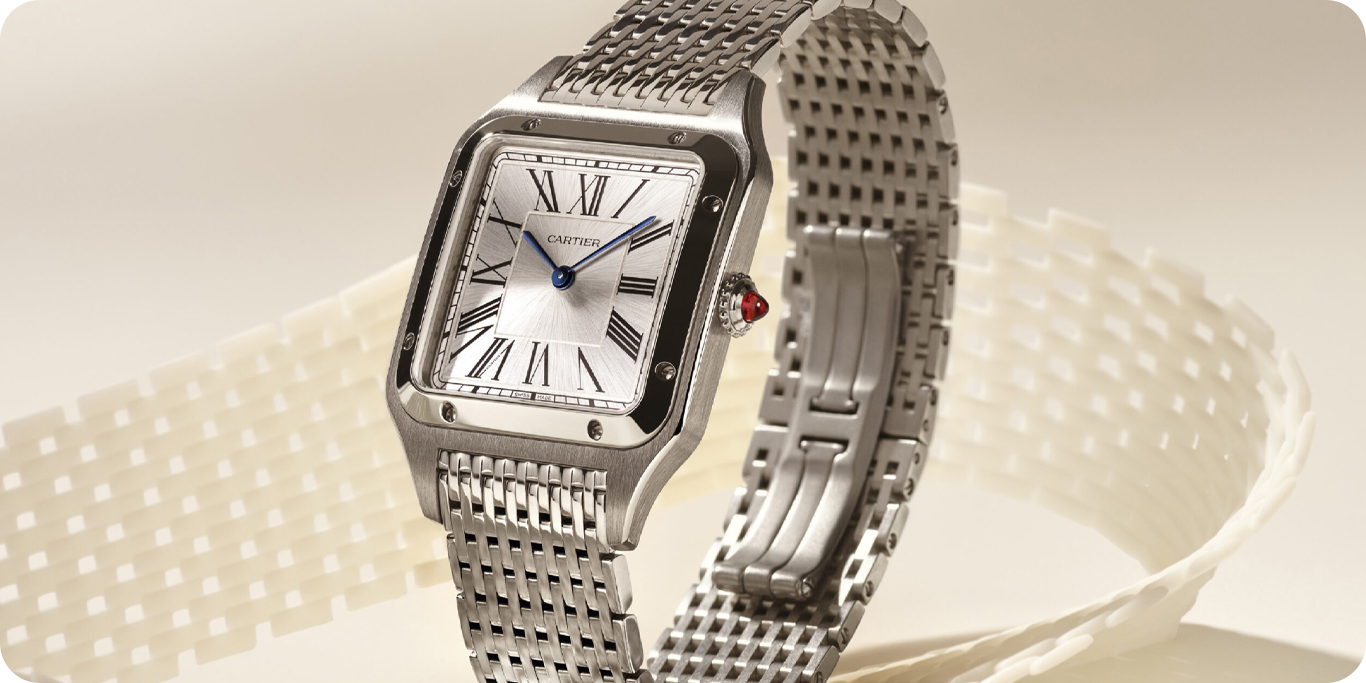
If the Roadster is about refinement, the Santos-Dumont is about restraint. Cartier leaves the case alone, which is the right decision. The square profile, exposed screws, cabochon crown, Roman numerals, all of it remains intact. The change sits on the wrist.
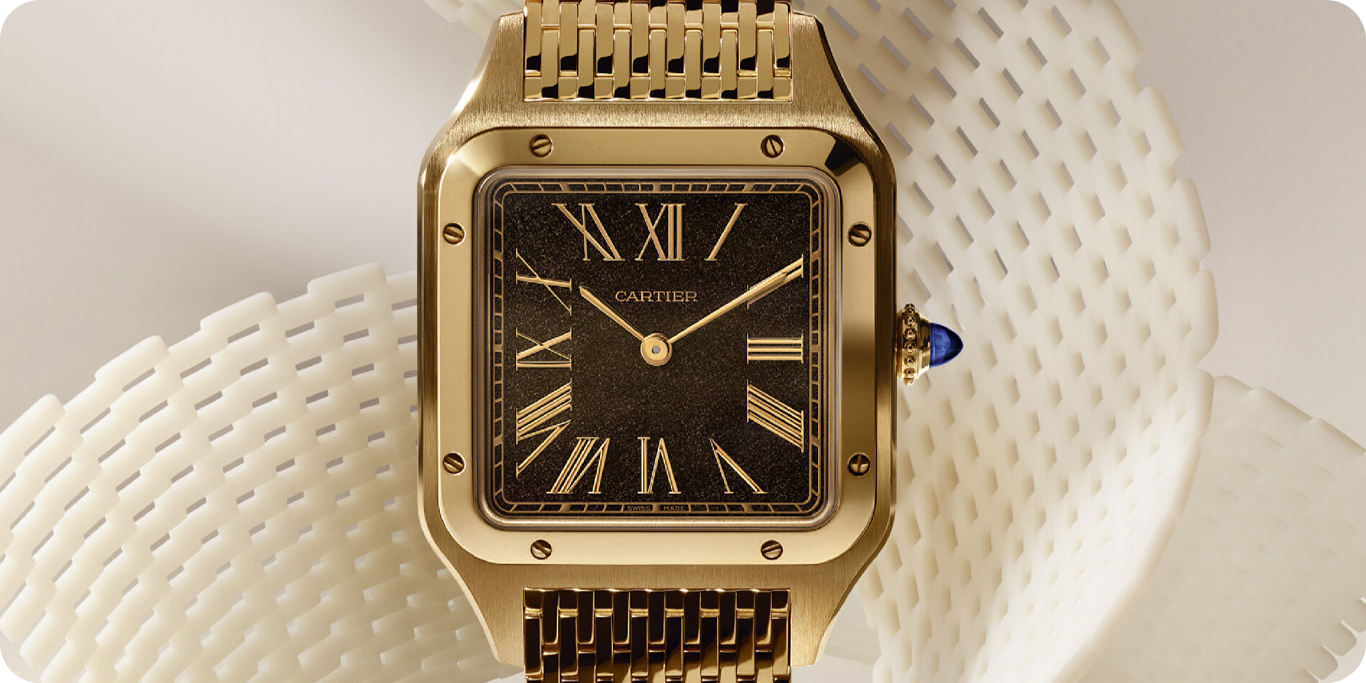
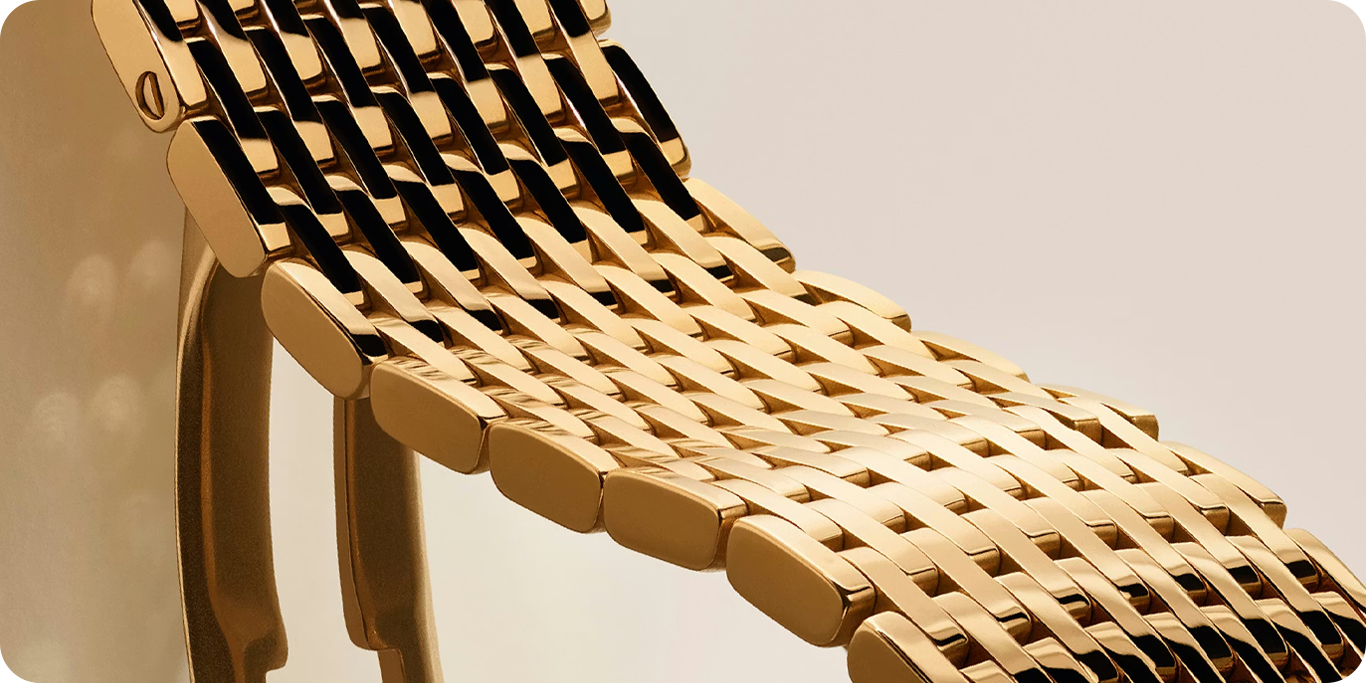
The new bracelet draws directly from Cartier’s own 1920s metal straps, built as a series of small, closely spaced links that drape more like fabric than a conventional bracelet. That difference is immediately noticeable. It shifts how the watch wears without altering how it reads. The obsidian-dial version leans further into that idea, pairing a stone dial cut to a fraction of a millimeter with a full gold bracelet, pushing the watch slightly closer to jewelry without abandoning its original identity.
This is the most subtle release in the lineup, and it’s also one of the most resolved. Nothing here asks for attention, which is exactly why it works.
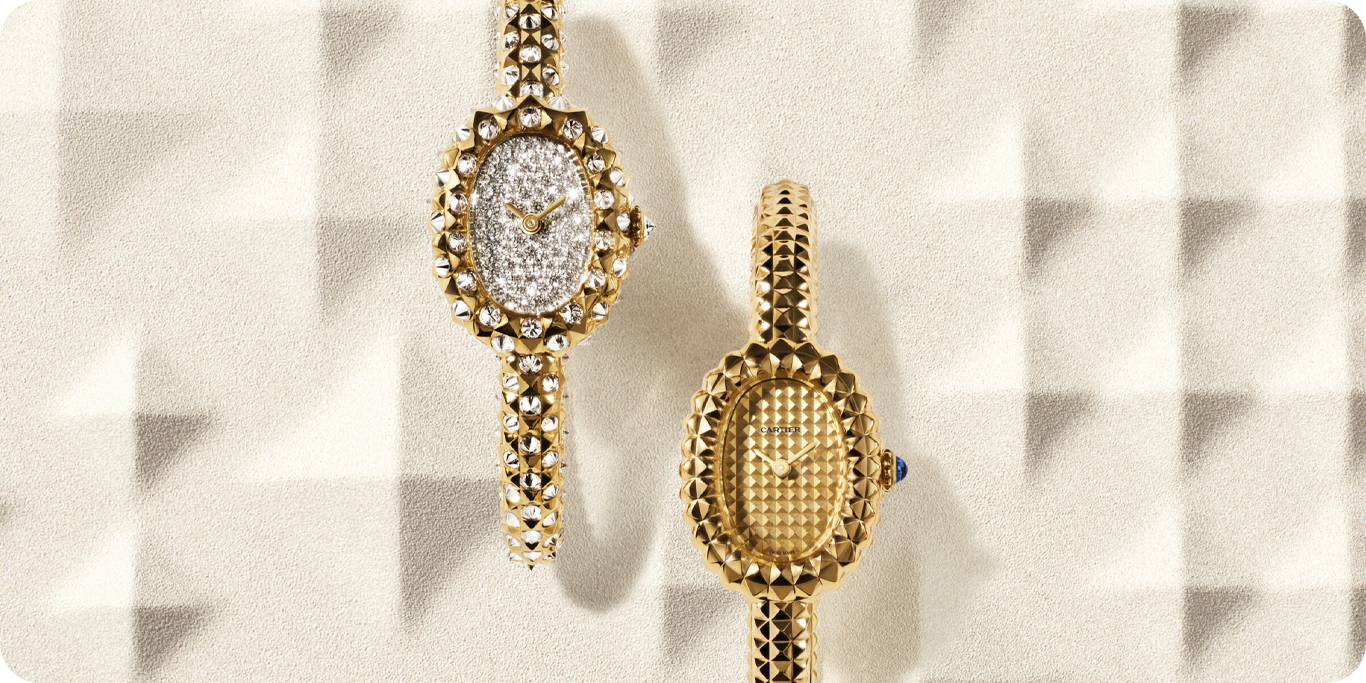
The Baignoire takes the opposite approach. Where the Santos-Dumont holds back, this one leans in. The familiar oval case is still there, but it’s now covered entirely in Clou de Paris, a pattern of small, hand-polished pyramids that Cartier has used for decades across both watches and jewelry.
Applying that texture to a curved surface changes the effect. On a flat dial, Clou de Paris reads as detail. Here, it becomes the defining feature. The geometry pulls against the softness of the case, creating a tension that is hard to ignore. It’s a confident move, but one that sits right on the edge of excess, especially in the diamond-set version.
That balance is the point. The Baignoire has always been more about shape than function. This iteration pushes that idea further, asking how much surface a case can carry before it overwhelms the form underneath. It gets close, but doesn’t quite cross the line.
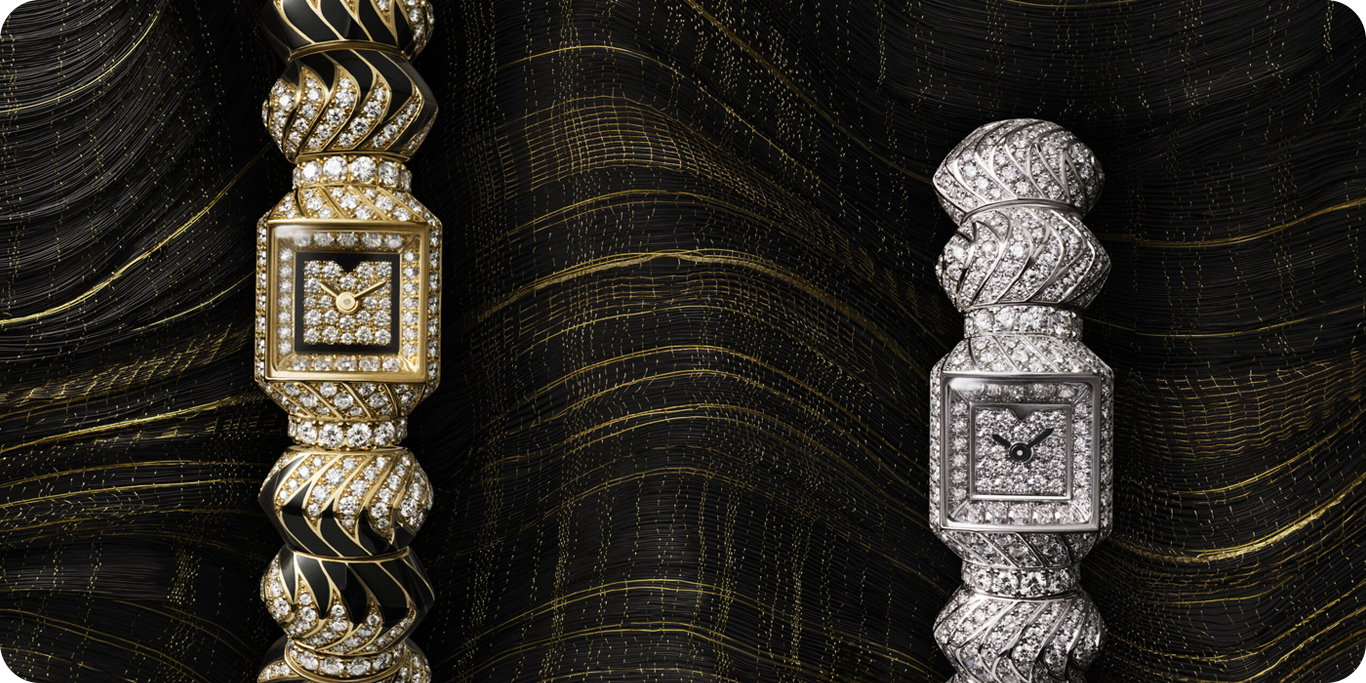
The Myst goes further. This is the least conventional watch in the lineup, and arguably the least concerned with being one in the traditional sense. Cartier references the jewelry watches produced under Jeanne Toussaint in the 1930s, but the connection is more conceptual than literal. The watch is built around a clasp-less bracelet that expands and contracts through an internal mechanism, turning the entire piece into something closer to an object than an instrument.
Everything about it reinforces that direction. Both versions are set heavily with diamonds. The yellow gold model introduces black lacquer and onyx, while the white gold version pushes fully into pavé. The time display is almost secondary to the structure around it.
Cartier is not trying to justify this through watchmaking. It doesn’t need to. The Myst exists to show what happens when the brand leans entirely into form, volume, and surface. Whether that reads as compelling or excessive depends on what you expect from a watch in the first place. Cartier seems comfortable leaving that question open.
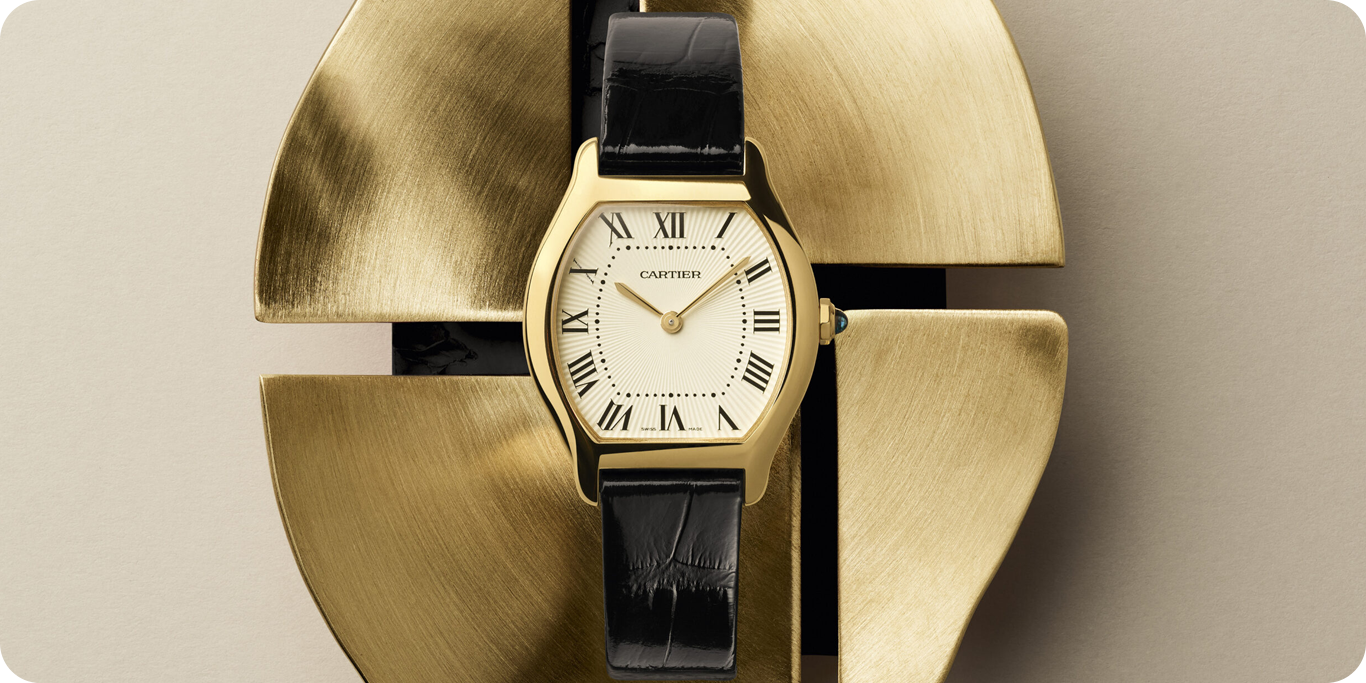
The Tortue brings things back to more familiar ground. First introduced in 1912, the case has been revisited repeatedly, and this version continues that process by softening the lines and rounding the proportions across a range of executions.
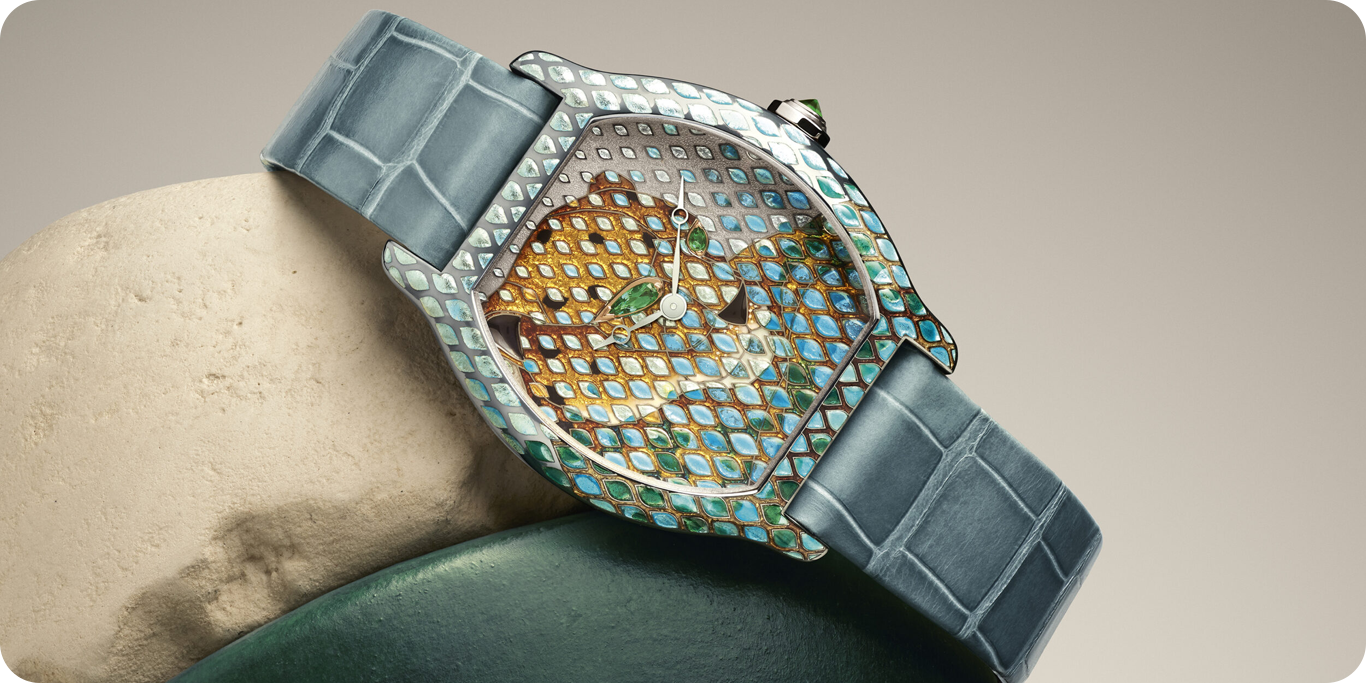
The everyday models are straightforward, offered in multiple metals and sizes with optional diamond settings, but they primarily serve as context for the métiers d’art piece. The Panthère Tortue is the one that defines this release. A scene of a panther in the rain is rendered in champlevé enamel, a technique that involves carving channels into metal and filling them with enamel before firing. Here, the work extends beyond the dial and into the case itself, creating a continuous surface.
This is where Cartier reinforces its authority. Not through complication, but through craft. The watch doesn’t need to explain itself. The execution does that on its own.
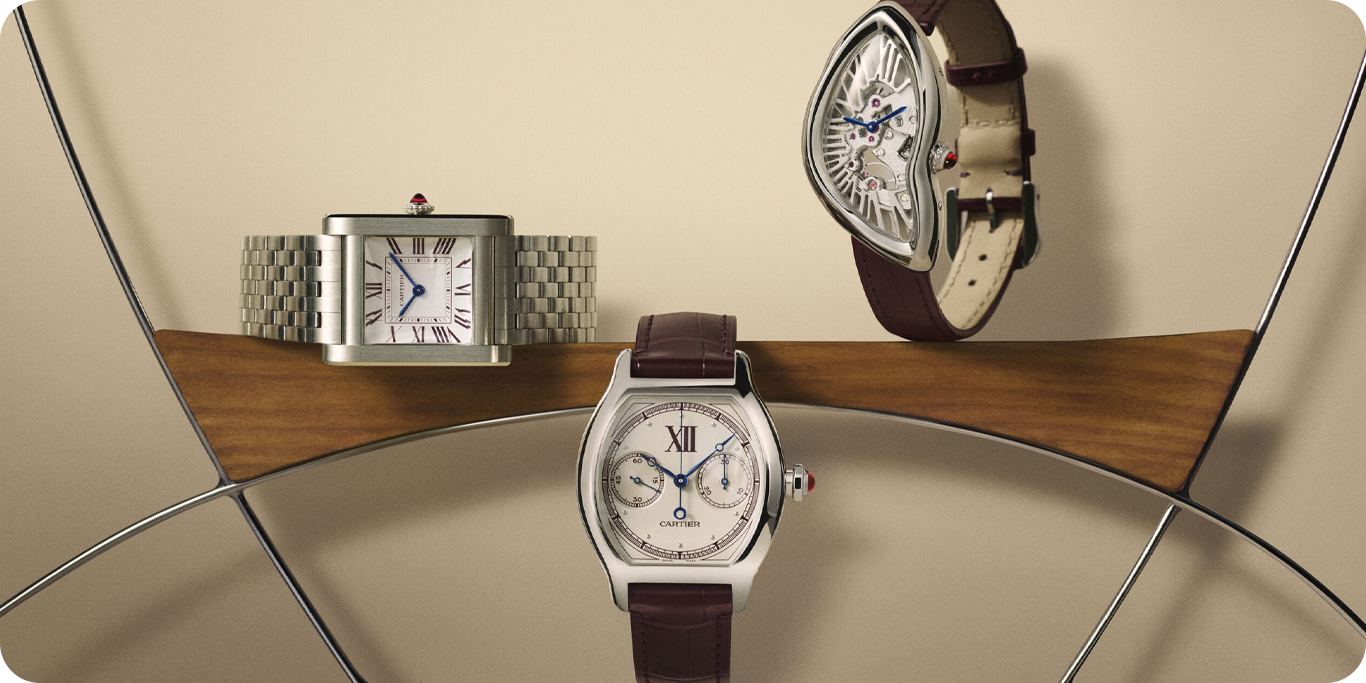
A decade in, the Privé program has settled into a clear role within Cartier’s broader output. It’s where the brand speaks directly to collectors, revisiting its archive with just enough adjustment to keep things moving forward. This year, the structure changes. Instead of focusing on a single model, Cartier presents two trios.
The first leans into contrast. Platinum cases, burgundy accents, and a set of recognizable shapes, including the Tank Normale, Tortue Chronographe Monopoussoir, and Crash Squelette. The Crash, in particular, stands out, not just for the case but for the movement inside it, shaped to follow the asymmetry rather than sit within it. It’s an approach that feels more deliberate than earlier executions, even if access will be limited.
The second trio is quieter. Yellow gold cases, restrained dials, and manually wound movements across the Tank Normale, Cloche, and Cintrée. It’s less about spectacle and more about continuity. Cartier has already suggested this is only the first chapter of a broader series, which positions Privé less as a yearly event and more as an ongoing framework.
Taken together, the two trios feel slightly scattered, but that may be intentional. At ten years in, Cartier is less interested in defining what Privé is than in expanding what it can accommodate.
Cartier’s advantage isn’t depth in a single direction. It’s control across multiple ones. The Roadster, the Santos-Dumont, the Baignoire, the Myst, the Tortue, and the Privé releases are all doing different things, speaking to different audiences, and operating at different points along the spectrum between watchmaking and jewelry. What ties them together is consistency of intent. Cartier knows exactly how each piece should read. That level of control is harder to maintain than it looks, and it’s what separates this showing from the rest of the field.
Bezel is the top-rated marketplace for buying and selling luxury watches. We give you access to tens of thousands of the most collectible watches from the world's top professional sellers and private collectors. Every watch sold goes through our industry-leading in-house authentication process, so you can buy, sell, and bid with confidence.
Download the Bezel app on the iOS App Store or start searching for your next watch today at getbezel.com.
Bezel is available to download on the App Store now. Please reach out to our concierge team if there is anything we can help you with!

©2026 Bezel Inc.
All rights reserved.