
Compare the nine cheapest Audemars Piguet references, including the Huitième, Millenary, and discontinued Royal Oak Lady.
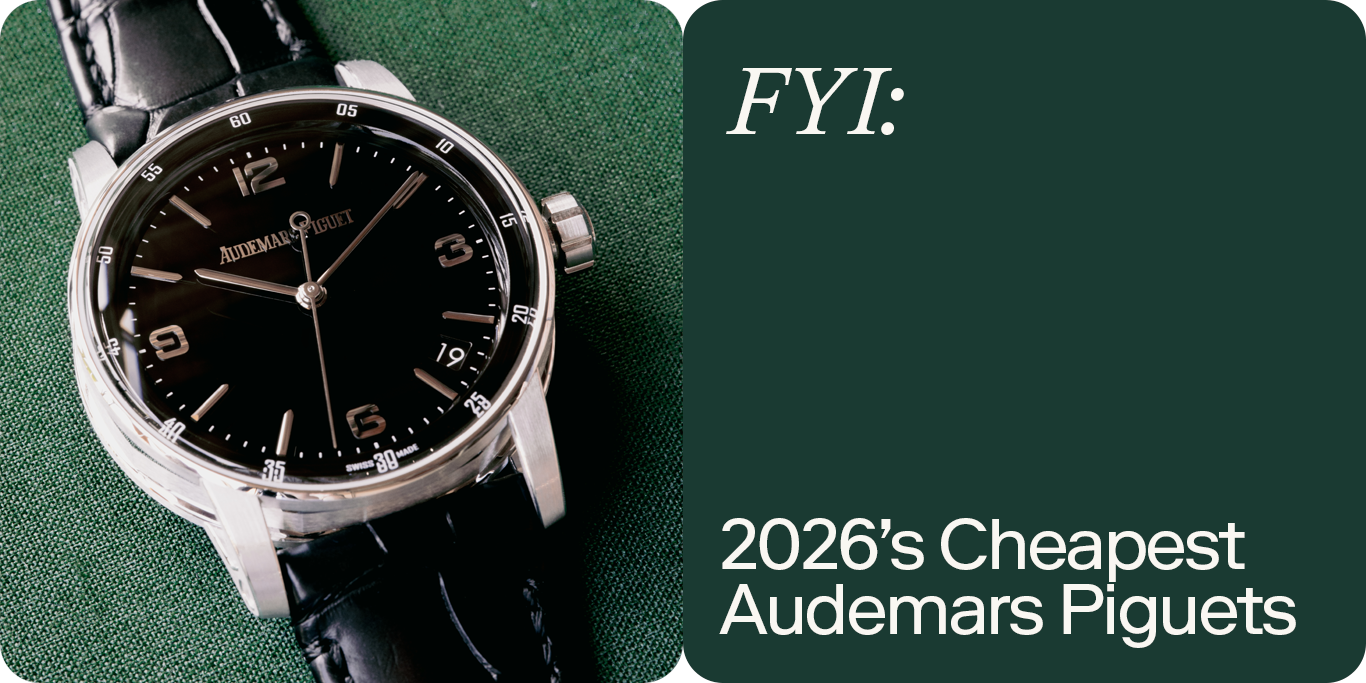
The cheapest Audemars Piguet you can buy isn't a Royal Oak. It's a pre-owned dress watch or a discontinued neo-vintage reference, and depending on which one you find, it can be had for somewhere between $2,000 and $8,000.
The cheapest Royal Oak, by contrast, starts at $19,900 at retail for a 33mm quartz model, with automatic versions opening at $30,400, which is a different conversation entirely.
That gap is why this list runs in the order it does, and worth understanding before you shop Audemars Piguet watches.
There are two answers, and which applies depends on what you're asking.
If you want the least expensive watch with Audemars Piguet on the dial, the floor sits in the low four figures. Well-kept gold dress watches from the 1940s through the 1960s trade for a little over $2,000, and the discontinued Huitième and Meridian lines start around $6,400.
A Royal Oak is a different question entirely. WatchCharts puts the model between roughly $7,000 and $696,000, averaging near $50,000, and the practical way in is an older quartz Royal Oak Lady at around $10,000 pre-owned.
The two answers get conflated constantly, which is how someone with $8,000 to spend concludes the brand is out of reach when it isn't. For comparison, the cheapest Rolex sits under either figure.
This list runs from the lowest real market price upward, not the lowest sticker price, because retail and market move in opposite directions across this catalog. Every figure reflects mid-2026 trading and prices on discontinued references drift, so treat them as a starting point rather than a quote.
Before the Royal Oak, Audemars Piguet built its name on thin gold dress watches and complicated pocket pieces, and those mid-century references remain the cheapest way to own something the company actually made.
Cases run small, usually 32mm to 34mm, almost always in yellow or white gold, and most are manual wind. Well-preserved examples turn up for a little over $2,000, which is Tudor money for a watch built in Le Brassus.
Servicing is where the cost hides: an unmarked vintage AP calibre takes money and patience to put right, and the parts aren't sitting on a shelf. Ask for an Extract from the Archives before you commit to any vintage AP, since it's the only document tying a specific case and movement to a production date.
Almost nobody writing about affordable APs mentions either of these, which is how they stay cheap.
AP's own archives date the Huitième to 1988, and the reference behind it, the 25644, grew out of the brand's first automatic chronograph with a date, a 40mm watch considered oversized in its era and sold accordingly. The Meridian followed in the 1990s, an ultra-thin sports watch with an indexed bezel and an integrated beads-of-rice bracelet.
Steel Huitième examples start around $6,400 and gold ones run to roughly $17,000, with the Meridian generally lower. You get Le Brassus finishing and a modular chronograph on an ultra-thin base calibre at under half the price of a comparable Royal Oak.
What you give up is recognition. Nobody at dinner will know what it is. Bezel keeps a standing Audemars Piguet Huitième page for when examples surface.
Named for one of the founders, the Jules Audemars line was AP's classical register: round cases, small seconds, in-house calibres, and none of the octagonal hardware the brand is now known for. It ran alongside the Royal Oak for decades and carried some of the company's most serious watchmaking, perpetual calendars and minute repeaters included.
It's cheap, and not for any reason touching quality. Demand sits almost entirely with the Royal Oak, which means a Jules Audemars gives you more hand finishing per dollar than any Royal Oak at any price.
Time-only and small-seconds references sit at the bottom of the Jules Audemars range, with complications climbing fast from there.
Introduced in 1996, the Millenary carries the largest retail-to-market spread in the catalog.
A hand-wound reference like the 77247OR listed at $35,900 new and used examples have traded between $10,000 and $15,000, so buying second-hand means paying roughly a third of what the first owner did.
The oval case and off-center dial explain it, since this is a polarizing watch and the market prices that in honestly. If the design works for you, the AP Millenary is arguably the best value the brand has offered. If it doesn't, no discount fixes that.
A founder's name, a rectangular case, and a collection AP quietly retired in the 2000s. It ran in steel and gold across everything from time-and-date models to chronographs and a platinum minute repeater, and it's the most overlooked shape in the brand's modern history.
Gold chronograph references commonly sit between $10,000 and $18,000, with simpler examples turning up lower, and it's low demand doing that pricing rather than condition or provenance, which makes an Edward Piguet in good order one of the few APs where patience gets rewarded.
If the octagonal bezel is the whole point for you, this is the cheapest way to get it.
The older Royal Oak Lady references ran quartz movements in cases around 33mm, and Chrono24 puts good-condition examples from roughly $10,400, the lowest entry into the Royal Oak line anywhere on the market.
They're small, battery-powered, and were sold as women's watches, which is the entire reason they're affordable while every steel Royal Oak in current production trades over list. The bezel, the tapisserie dial, and the integrated bracelet are all present. Bezel's Audemars Piguet listings between $10,000 and $20,000 are where these tend to sit.
This is the cheapest Royal Oak you can order new, and the cheapest new AP of any kind, at $19,900 retail as of 2026. The case is 33mm of stainless steel at just 7mm thick, the dial carries the Grande Tapisserie pattern, and inside is the quartz Calibre 2713.
Two things get held against it: the quartz movement and the size. Neither is fatal. The 7mm profile slips under a cuff in a way no automatic Royal Oak manages.
Pre-owned examples on Bezel have started around $14,750, more than $5,000 under sticker for an otherwise identical watch, so look through the Royal Oak collection before you pay retail.
The 15710ST is where the math turns in your favor, a discontinued 42mm Offshore Diver rated to 300 meters, with an inner rotating dive scale worked by a second crown at 10 o'clock so the octagonal bezel stays fixed. It replaced the 15703 in 2017 and ran until the current 15720 took over.
Standard black and white dial examples have been listed from about $17,500. That puts an automatic Royal Oak with a real dive rating at or below the retail price of the 33mm quartz, which is the most useful thing to know if you want a mechanical AP for the least money.
Boutique color variants are a separate market and run to $32,000, so stay on the standard dials on the Royal Oak Offshore page. The color is what you'd be paying for.
AP launched CODE 11.59 in 2019 to give the catalog something that wasn't a Royal Oak, and collectors have argued about it ever since. The steel Selfwinding arrived in early 2023 with a 41mm case, an octagonal middle under a rounded bezel, a wave-textured dial, and the in-house Calibre 4302 running a 70-hour reserve.
It listed near $25,000 and trades below that used, which makes it the cheapest route to a full-size AP with an in-house automatic movement, and the discount exists for no reason other than that the design divides people.
If it doesn't divide you, CODE 11.59 is the value play in the current lineup.
Knowing which direction a reference trades matters more than any single price, because retail and market run opposite ways across this catalog.
WatchCharts recorded the Royal Oak rising 2.7% in the first quarter of 2026, with nearly every in-production reference trading above list. That $19,900 sticker is real only if you have a boutique relationship. Most buyers don't.
Discontinued references don't all stay cheap either. WatchCharts has the midsize 14790 up 13.6% over the past year, outpacing its own brand index, which is how a watch drifts out of a list like this one.
The dress collections invert it. Jules Audemars, Millenary, Edward Piguet, and CODE 11.59 all trade below what they cost new, sometimes far below, because the demand lifting steel Royal Oaks never reaches them.
A quoted retail price on a steel Royal Oak is a bargain worth taking, and the same quote on a CODE 11.59 means you should check the secondary market first.
Box and papers matter more here than on an expensive AP, because the paperwork is a larger share of what you're paying for, and where they're missing an Extract from the Archives does most of the same work.
Ask when the watch was last serviced and by whom, because an unserviced vintage calibre is a bill you've quietly inherited rather than a discount you've earned.
Dial and hand originality can separate two apparently identical vintage references by several thousand dollars, and refinished dials and replacement hands are common on watches this old and often go undisclosed. On anything with an integrated bracelet, check for stretch by holding the watch horizontally and looking for sag between the links.
The sub-$8,000 band is the most dangerous part of the AP market precisely because a low price looks plausible in it, which is why a watch priced meaningfully below market should read as a warning rather than a find.
Every listing on Bezel clears in-house authentication before it ships, and the best AP watch roundup covers what the money buys further up the range.
Yes, with one condition. A $7,000 Huitième is better finished than almost anything else at that price, and it came out of the same building as a $200,000 perpetual calendar. It also will not be mistaken for a Royal Oak by anyone, ever. That's the trade.
Which way you go depends on what you're buying.
If you want the octagonal bezel and the integrated bracelet and the recognition they carry, budget $17,500 and up and ignore the bottom of this list. If you want AP watchmaking for the least money, the bottom is the only place it exists, and the discount is real rather than a compromise.
Anyone weighing the same question across brands should start with entry level luxury watches.
The cheapest APs are pre-owned dress and discontinued references in the $2,000 to $8,000 band. The cheapest new one is the 33mm quartz Royal Oak at $19,900, and the cheapest automatic Royal Oak is a discontinued Offshore Diver from around $17,500.
Which is right for you comes down to whether you're buying the shape or the watchmaking. Bezel's sellers cover all of it, from four-figure vintage to current steel Royal Oaks, every watch authenticated in-house before it changes hands. Start with Audemars Piguet on Bezel and filter by what you can spend.
Bezel is available to download on the App Store now. Please reach out to our concierge team if there is anything we can help you with!

©2026 Bezel Inc.
All rights reserved.