
What is an anchor watch? Explore how collectors define the watch that shapes their collection through three distinct relationships.

Most collections start with a different set of ideas than the ones that end up defining them.
Early on, the language tends to revolve around grails and daily wearers. The grail is the watch that exists at a distance, something to work toward, something that sits outside your current reality. The daily wearer is the opposite, chosen for practicality, durability, and how easily it fits into the rest of your life. Both are useful categories, but neither really captures the watch that ends up mattering most.
At a certain point, usually without much warning, a different kind of piece takes hold. It doesn’t necessarily look like the most impressive watch in the collection, and it isn’t always the one you wear the most. What it does is change how you see everything else. It resets your sense of proportion, of taste, of what feels worth adding and what doesn’t.
Other watches start to orbit around it, whether you intended that or not. You don’t always recognize it when it happens, and in most cases the recognition comes later, once enough time has passed to see what stuck and what didn’t. The watch was already there. It just took a while to understand what it had become.
There are a few different ways that relationship tends to form, and most collectors fall into one of them.

Some watches ask something of you before you’re ready to answer. It might be a color you would have dismissed a year earlier, or a design that feels more exposed than anything else you own. There’s a moment where it doesn’t quite make sense yet, where the decision feels slightly ahead of your own taste. Saying yes at that point is less about certainty and more about instinct.
The Rolex Oyster Perpetual 36 in yellow is a clean example of how that plays out. The Oyster Perpetual had spent years as the watch people were supposed to move past, a minimal Rolex with a strong movement and very little else to point to. When the lacquer dial versions arrived in 2020, the platform didn’t change. The 36mm Oystersteel case, smooth bezel, Oyster bracelet, and Calibre 3230 remained exactly as they were. What shifted was the dial, and with it the way the watch was read.
Yellow was the version that required the most conviction. Turquoise turned into a phenomenon almost immediately, and coral red gained traction once it became clear it wouldn’t be around forever. Yellow never really had that kind of external validation, and it didn’t come with a narrative that made the decision easier to explain. Wearing it meant accepting that you were choosing it for your own reasons, without much support from the market around you.
Collectors who moved early on it ended up with something more than a successful reference. They ended up with a watch that clarified their own taste ahead of time. The appeal didn’t arrive later. It was already there, just not fully understood yet.
You see the same pattern at a different scale with something like the Royal Oak Offshore Diver, where the core Royal Oak language is pushed into something more aggressive, or with the turquoise Daytona, where a dial that initially felt like an outlier becomes one of the defining references of its era. The common thread isn’t the watch itself. It’s the moment of saying yes before it’s obvious.
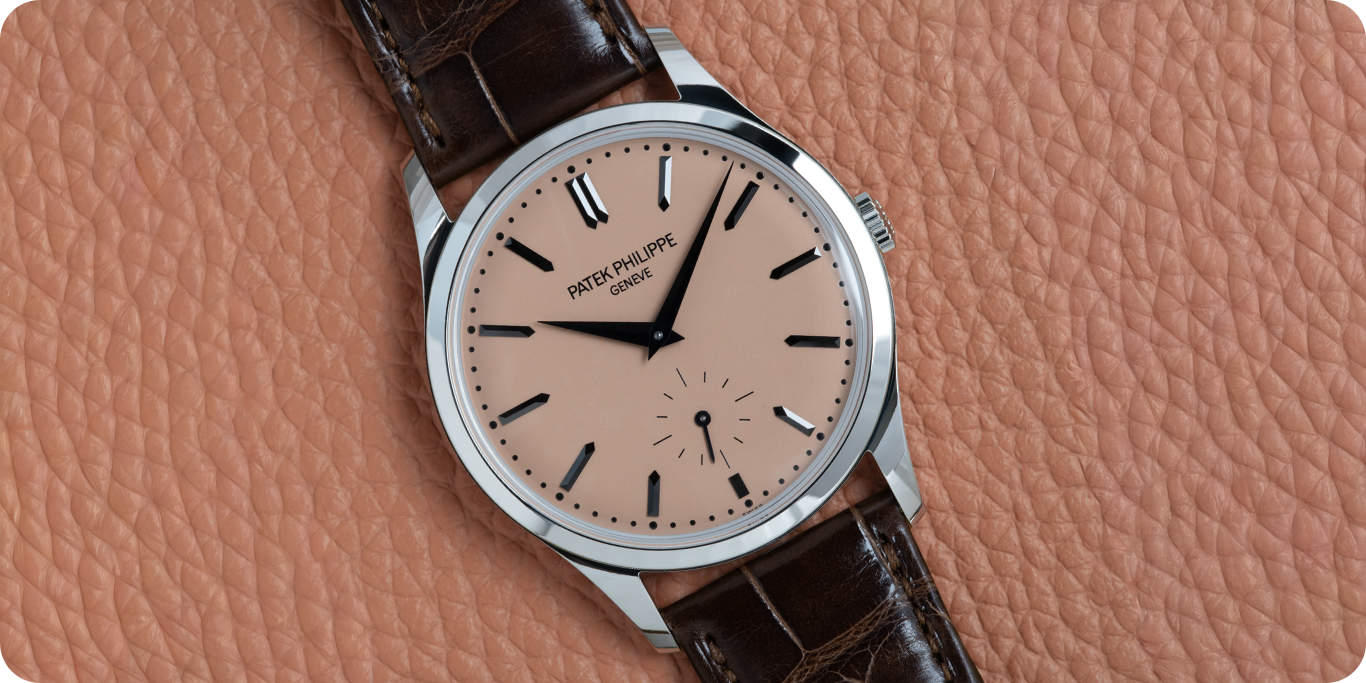
Some watches don’t ask anything of you at first. You see them, register them, and move on. They don’t compete with the pieces that are easier to understand or easier to explain, especially early on, when collecting is still tied to external signals. There’s always something louder, something more complicated, something that feels like a clearer expression of progress.
The Patek Philippe Calatrava ref. 6196P sits squarely in that space. When it arrived as the successor to the long-discontinued 5196, it didn’t try to reintroduce itself. A 38mm platinum case, a salmon dial with anthracite obus-style markers, and a hand-wound movement visible through a sapphire back. The finishing is exacting, the proportions are controlled, and the movement introduces twin barrels to deliver 65 hours of power reserve with an accuracy spec that sits tighter than most of what surrounds it.
What defines it is the way collectors arrive at it. It tends to come after years spent with chronographs, perpetual calendars, and sports references, after the phase where each new acquisition needs to signal something clearly. The Calatrava doesn’t compete on those terms. It sits in the background until the rest of the noise starts to fall away.
The details that matter here don’t announce themselves immediately. The dial surface, the way the watch disappears under a cuff, the balance between the case and the movement—these are things that accumulate over time rather than presenting themselves all at once. When the watch finally clicks, it tends to feel obvious in hindsight, even if it took years to get there.
That same arc shows up in other places. The Tank Chinoise is often passed over early, read as something closer to fashion than to watchmaking, and then revisited later with a different set of priorities. The Perpetual 1908 plays a similar role within Rolex, especially for collectors who have moved through the sports catalog and are ready for something that doesn’t rely on that identity.
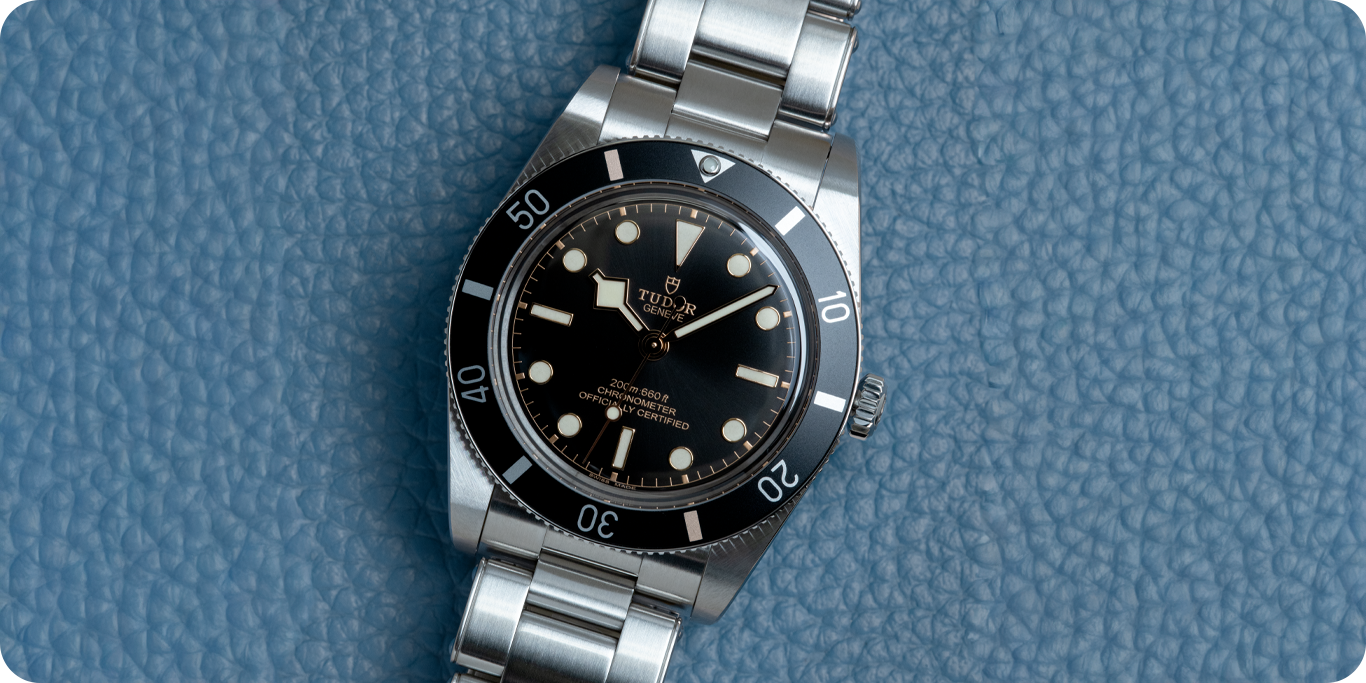
Some watches don’t require a process. You put them on and the decision resolves itself quickly, without needing to be worked through. There’s no sense of taking a risk or waiting for the relationship to develop. The fit is immediate, and it stays that way over time.
The Tudor Black Bay 54 sits in that position more completely than most. The design pulls directly from the 1954 reference 7922, with a 37mm case, a simple bezel, and a no-date dial with gilt accents. What it adds is everything a vintage watch can’t reliably offer, from a COSC-certified movement to a silicon balance spring and a 70-hour power reserve, all within a case that sits just over 11mm thick and wears cleanly across a wide range of wrists.
The appeal isn’t primarily about value, even though the value is clear. It has more to do with how easily the watch settles into use. It wears slightly larger than its dimensions suggest, balances well on most wrists, and doesn’t ask for justification in the way more complicated or more expensive pieces often do. It becomes the watch you reach for without thinking about it, which tends to be the one that gets worn the most.
Other versions of this exist at different levels. The Daytona with a white dial and black subdials has a similar clarity for collectors focused on chronographs, and the Speedmaster Moonwatch occupies the same space for anyone drawn to manual-wind chronographs with a well-established design language. In each case, the decision feels resolved from the start.

The difference between these watches isn’t really about category.
It comes down to how the relationship forms. Some watches ask for a leap before you’re ready, some take years to come into focus, and some make sense immediately. The outcome tends to look similar in each case, with one watch becoming the point of reference for everything that follows.
What’s harder to pin down is when that shift actually happens. In most cases, you don’t recognize it in real time. The watch is already part of the collection, already worn and understood in a basic sense. The realization comes later, when you start to notice that everything else is being measured against it.
That’s the point where it stops being just another watch you own and becomes something closer to a foundation.
Bezel is the top-rated marketplace for buying and selling luxury watches. We give you access to tens of thousands of the most collectible watches from the world's top professional sellers and private collectors. Every watch sold goes through our industry-leading in-house authentication process, so you can buy, sell, and bid with confidence.
Download the Bezel app on the iOS App Store or start searching for your next watch today at getbezel.com.
Bezel is available to download on the App Store now. Please reach out to our concierge team if there is anything we can help you with!

©2026 Bezel Inc.
All rights reserved.