
Most buyers know counterfeits exist, but what’s less obvious is the extent to which some of them replicate the details of popular luxury watches.
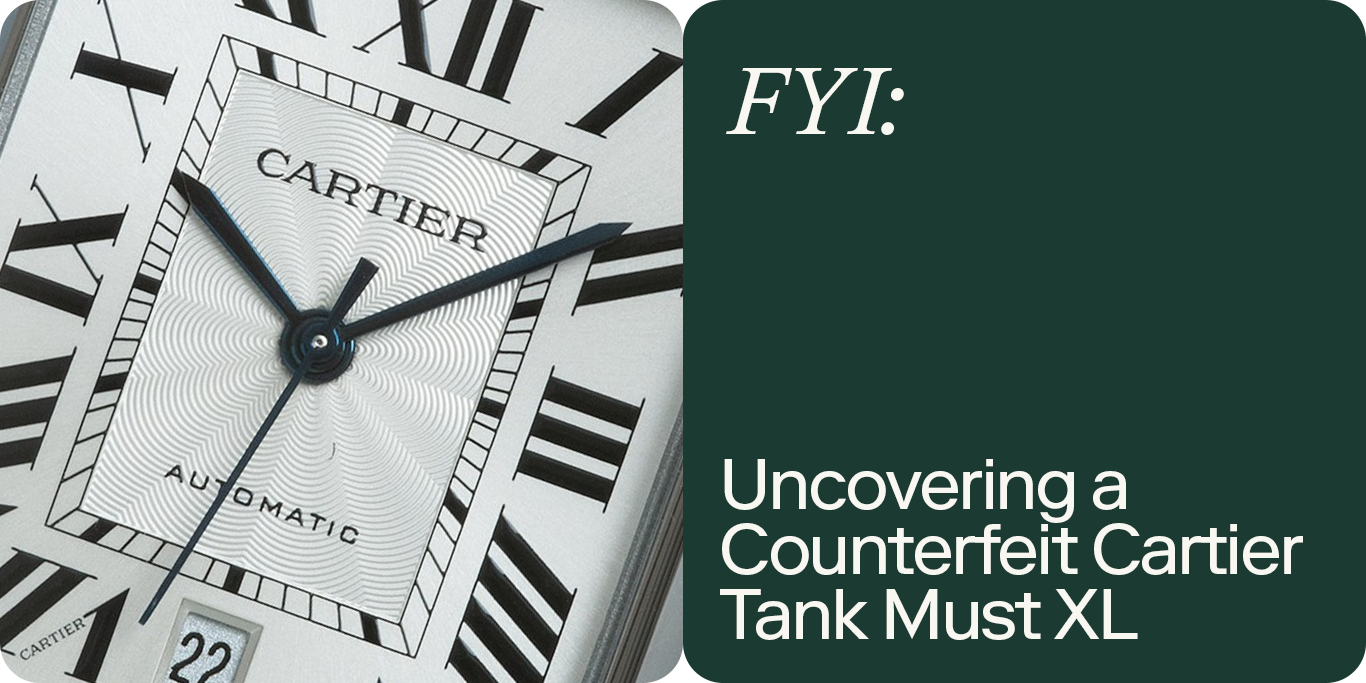
Most buyers know counterfeits exist, but what’s less obvious is the extent to which some of them replicate the details of popular luxury watches. While many fail authentication examinations quickly under even light scrutiny, others are constructed to survive the first pass, relying on coherence rather than perfection. This case fell firmly into the latter category.
A recent attempted sale of a Cartier Tank Must XL on Bezel illustrated how a watch can appear internally consistent, visually convincing, and broadly familiar, yet still unravel when examined beyond the surface. It’s a reminder that modern authentication isn’t about confirming what looks right. It’s about testing whether everything holds together when the watch is taken apart.
The watch was listed as a Cartier Tank Must XL, reference WSTA0053, and followed Bezel’s standard process: purchased by a buyer, then sent in for authentication before release. On arrival, nothing demanded immediate concern. The case shape was familiar, the proportions looked right, and the overall presentation matched what most buyers would expect from the model.
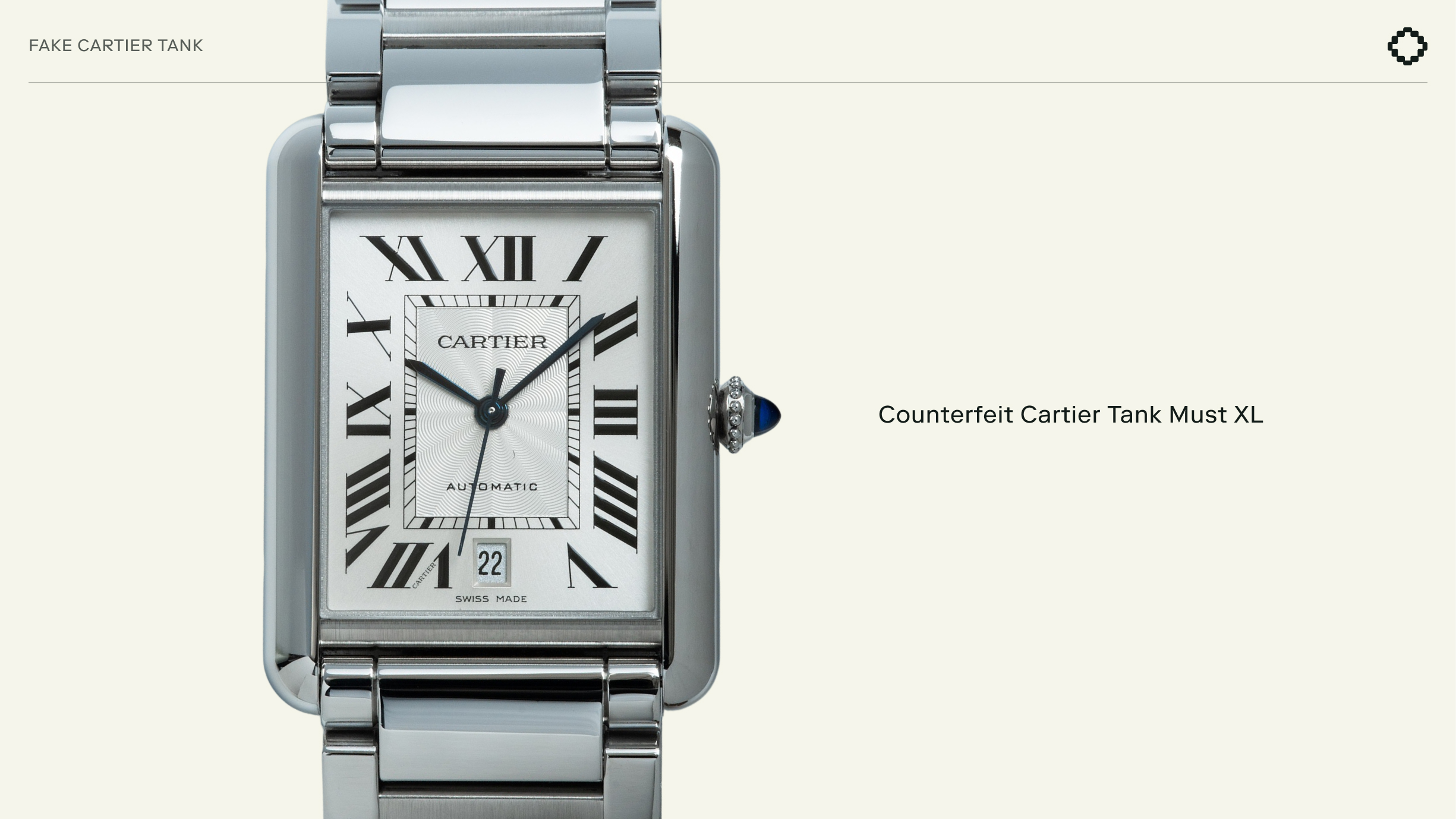
Closer inspection shifted that impression. The dial no longer held up as it did at first glance. Under magnification, small departures appeared in the shape of the numerals, and the typeface lacked the consistency seen on verified Cartier dials. The surface finish, while serviceable, lacked the uniform refinement typically seen on authentic dials. None of these details were dramatic on their own, but together they began to suggest something wasn’t adding up.
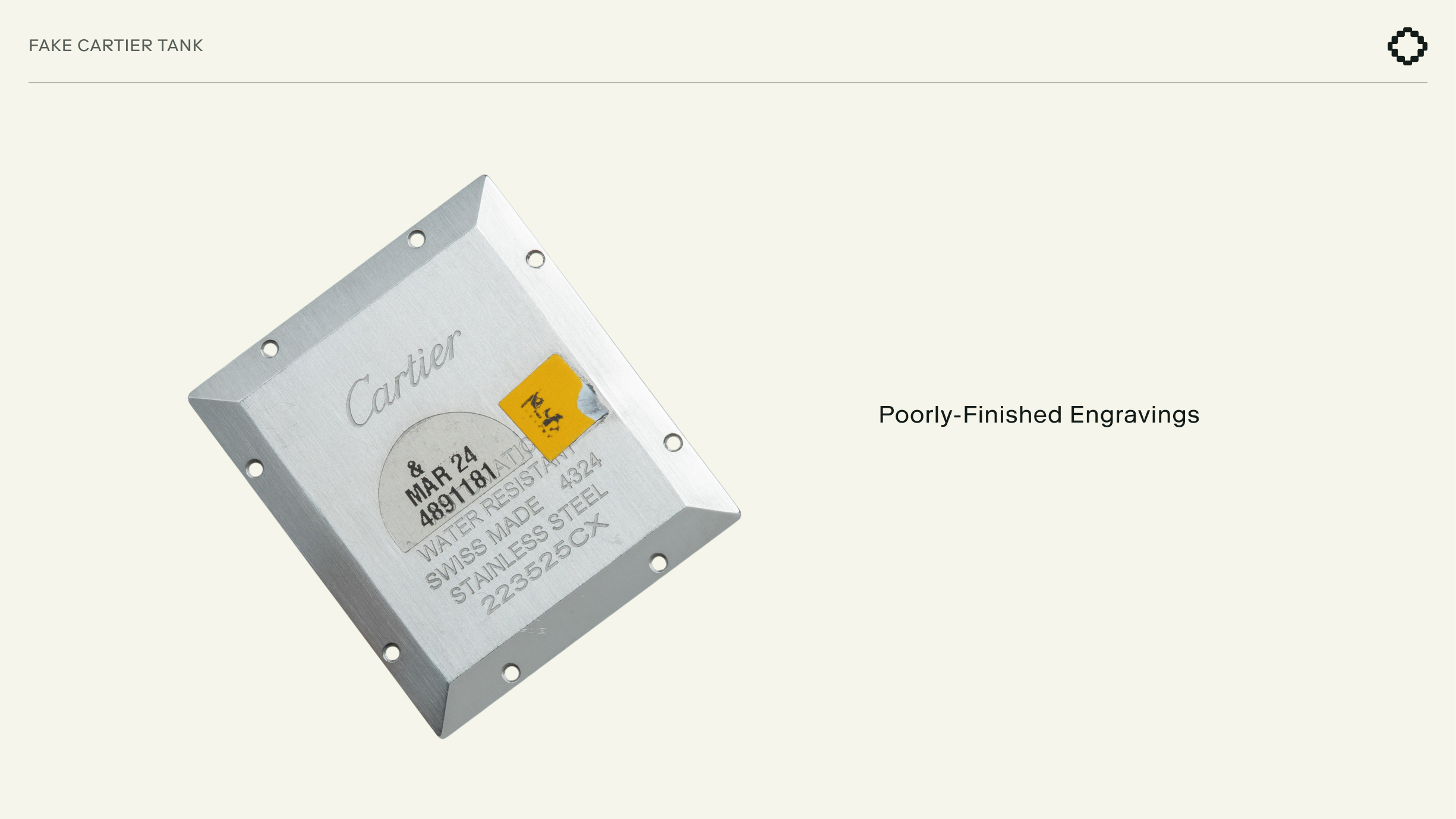
The case and bracelet added to that picture. Engravings deviated from Cartier’s usual execution, and the brushing and polishing were inconsistent across components. Instead of the controlled, repeatable finishing the brand is known for, the watch showed signs of uneven work, as though different areas had been handled separately rather than as part of a unified process.
With several irregularities identified, the watch was escalated to Bezel’s in-house watchmaking team for inspection of its movement. Inside the case, the situation became unambiguous when our watchmakers discovered something altogether different than Cartier's Caliber 1847 MC, which a genuine Tank Must XL should house.
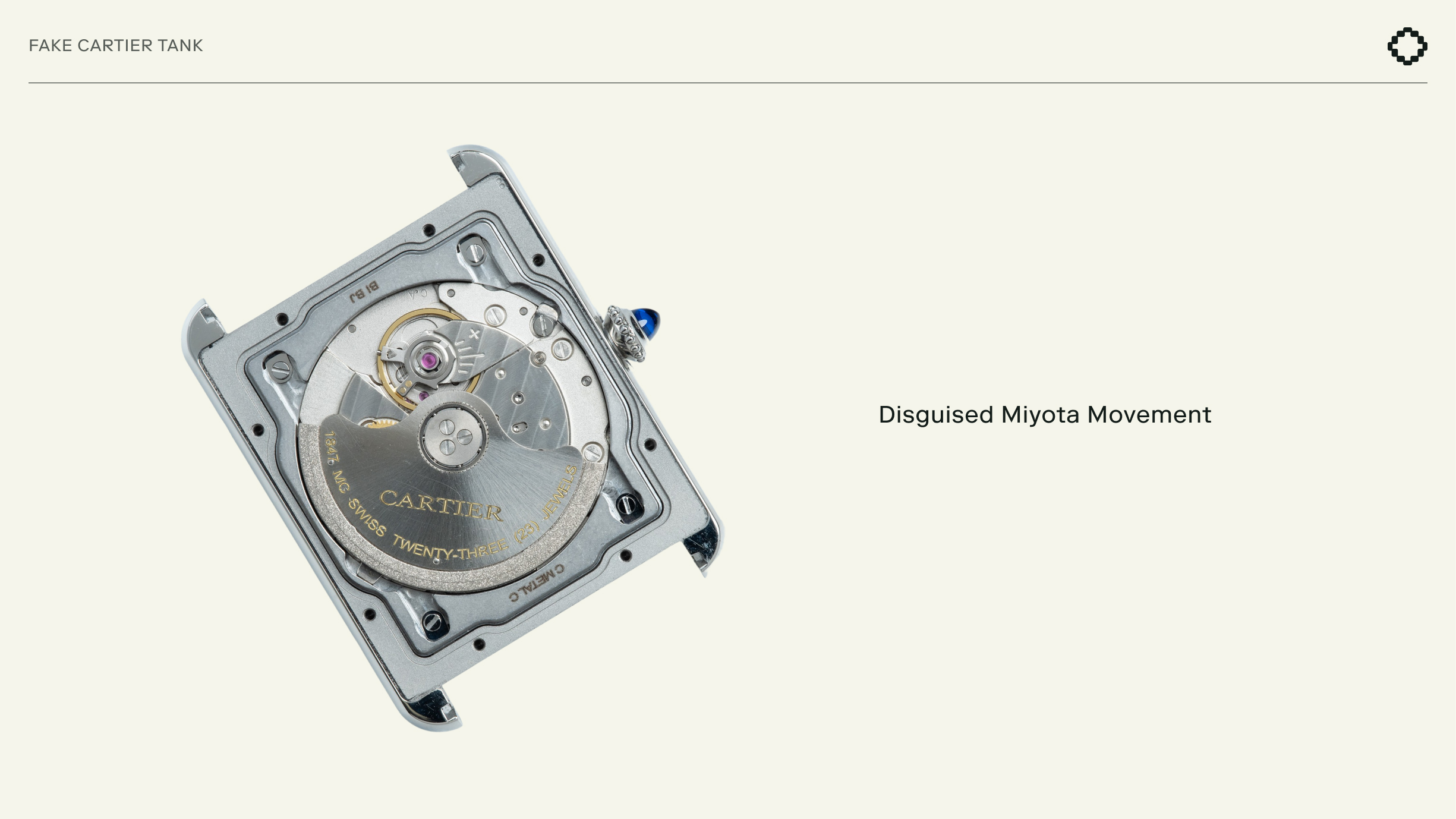
Instead, the watch contained a Miyota movement. While Miyota calibers are widely used and reliable in their own right, Cartier does not use them in this model. In this case, the movement had been cosmetically altered to resemble Cartier’s at a glance, but the underlying construction made its origin clear. At that point, there was no longer a question of partial correctness. The entire watch was not genuine.
The inclusion of an authentic Cartier guarantee card added an unusual layer. The card had not been factory-printed with the watch’s details and did not correspond to the piece in any legitimate way. Rather than documenting provenance, it appeared to serve as a form of reassurance. Its presence didn’t complicate the conclusion so much as underscore the effort to make the watch feel credible.
This was not a scenario involving wear, modification, or swapped components. Instead, the watch was built to imitate a legitimate Cartier, but it fell short at every meaningful level. If the transaction had been completed, the buyer would have taken delivery of a watch that did not match the description under which it was sold.
Issues like this rarely end at the moment of purchase. A counterfeit watch cannot be serviced by the manufacturer, cannot be described honestly in future sales, and often leaves the owner with limited options once the truth comes to light. The cost isn’t just financial. It’s the position the buyer is put in afterward.
As Bezel Chief Marketplace Officer Ryan Chong notes, “When someone buys a watch like this, they’re not looking for something close. They’re expecting exactly what’s represented. That’s what our process is built to protect.”
Every watch submitted to Bezel is evaluated as a complete object, not just a surface impression. This is why external details, construction quality, engravings, and documentation are all meticulously reviewed before any piece is cleared. When something doesn’t align, it’s escalated and examined further rather than explained away.
Bezel CEO Quaid Walker adds, “A watch shouldn’t require optimism from the buyer. If it’s being sold as something specific, it needs to stand up to that claim in every respect.”
In this instance, the sale was stopped before completion. The buyer was notified, refunded, and protected from taking possession of a counterfeit watch.
Cases like this show how far convincing counterfeits have come, especially when they focus on familiar designs. The watches that feel easiest to trust at a glance are often the ones that benefit most from closer inspection.
For anyone navigating the pre-owned market, the takeaway is simple and practical: don’t let recognition replace verification. Careful authentication makes sure that what arrives on your wrist matches what you thought you were buying.
Bezel will continue to share insights like this so collectors can better understand the realities of the secondary market and move through it with confidence.
Bezel is the top-rated marketplace for buying and selling luxury watches. We give you access to tens of thousands of the most collectible watches from the world's top professional sellers and private collectors. Every watch sold goes through our industry-leading in-house authentication process, so you can buy, sell, and bid with confidence.
Download the Bezel app on the iOS App Store or start searching for your next watch today at getbezel.com.
Bezel is available to download on the App Store now. Please reach out to our concierge team if there is anything we can help you with!

©2026 Bezel Inc.
All rights reserved.