
The Rolex waiting list isn't one list or a real queue. Learn how dealer allocation works, which references are actually attainable, and how to buy without waiting.
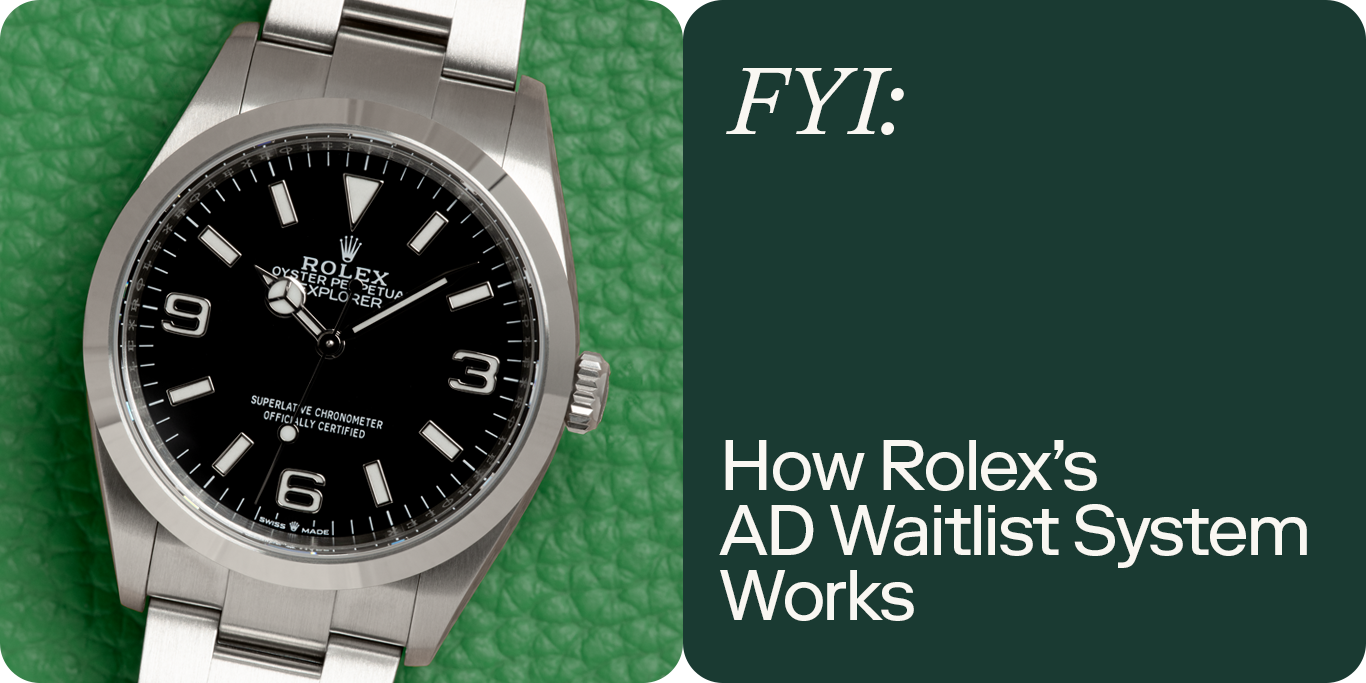
There is no true Rolex waiting list. There are a few thousand of them, one per authorized dealer, and not one operates as a queue where a place is held and a turn eventually arrives.
Waits run from walking out with a solid gold reference the same afternoon to something closer to permanent exclusion on a steel Daytona, and which end you land on depends far more on the reference you want and the dealer you want it from than on the date you asked.
The list is a record of interest rather than a position in a line. A salesperson notes that you want a particular reference, that note goes into that store's system, and when a watch arrives the dealer decides who gets it. Nothing obligates them to work through the names in order, and in practice they rarely do.
It also exists only at the store level. Give your details to the dealer nearest you and that's where they stay, shared at most with other locations in the same group, and invisible to every other dealer in the network.
Rolex maintains no central list, no online registration, and no mechanism for you to check a position, because there is no position to check.
How rigorously any of this gets recorded varies more than most buyers expect. Some dealers keep a genuine database, some keep it in a salesperson's memory, and some have stopped keeping lists at all.
Reporting out of Japan describes stores that abandoned lists entirely in favor of first-come queues on delivery days, which produced exactly the lines you would imagine. Other reporting on the subject makes the useful point that a confirmation email is the only reliable evidence you were recorded at all, and plenty of buyers never get one.
None of this is unique to the brand. It's just unusually visible at Rolex because the demand is unusually concentrated, and because the prices Rolex charges at retail sit well below what several references trade for elsewhere.
Rolex builds a great deal of watches. Morgan Stanley's annual estimates, produced with LuxeConsult, put annual output above a million units, which makes Rolex one of the largest producers of Swiss mechanical watches by a wide margin.
The constraint isn't volume. It's that demand concentrates on a narrow band of steel professional models while production spreads across a catalog of hundreds of references, most of which nobody is queuing for.
The dealer network compounds it. Rolex has spent recent years reducing its worldwide store count, which funnels the same demand through fewer doors and gives each remaining dealer a smaller allocation to distribute among a larger pool of interested buyers.
We've covered the demand side of this at length in our piece on why it is hard to buy a Rolex, so the short version will do here: the scarcity is real, it is partly structural, and it is not evenly distributed.
Quoting a wait in months is where most guides go wrong, and the reason is covered in the next section. What holds up better is sorting the catalog by how attainable a reference is, because that ordering stays consistent across dealers, markets, and years even when the timelines don't.
Effectively closed to new customers. Steel Daytonas sit here, along with the Le Mans reference and the off-catalog pieces Rolex produces in single-digit or low double-digit quantities. Some dealers have stopped adding names for steel Daytonas altogether, which is worth learning before you spend a year assuming you're on a list. Steel Sky-Dwellers in blue or mint green and the turquoise Oyster Perpetual belong in this tier too. Getting one is a function of your standing at a specific store rather than patience, and for most buyers no amount of waiting changes the outcome.
Genuine multi-year propositions. The Batman and grey and black GRNR GMTs, the green bezel Submariner 126610LV, and the newer pastel Oyster Perpetuals in lavender, beige, and pistachio. These are obtainable by ordinary customers who commit to one dealer and stay in contact, and the operative word is years.
Attainable with real but ordinary patience. The standard black bezel Submariner and Submariner Date, the Datejust 41 in its more requested configurations, the Explorer II, the Explorer 40, and the two-tone GMTs. An increasing number of buyers report clearing this tier in months rather than years, which is the most meaningful change in Rolex availability since 2021.
Frequently available from stock. Solid gold references across most collections, two-tone Datejusts, ladies' models, diamond-set pieces, the Explorer 36, and gold Sky-Dwellers outside the green dials. Several of these trade below their own retail price on the secondary market, which tells you most of what you need to know about the demand behind them.
One reference has left the system entirely. Rolex discontinued the Pepsi GMT at Watches & Wonders 2026, so the authorized dealer route for it is closed permanently rather than slowly. No wait applies to a watch nobody is building, and most published wait-time guides haven't caught up to that.
Read four articles about Rolex waits published this year and you'll get four irreconcilable answers for the same watch. One puts a steel Submariner at three months to two years, another at one to three years, a third reports a one to three month median across the entire catalog, and a fourth describes waits stretching past five years.
All four were written within months of each other, and almost none of them say where the numbers came from.
The spread isn't sloppiness so much as four different things being measured.
Configuration is the first variable, and it does most of the work: a black dial Datejust 36 and a turquoise Oyster Perpetual are both "a Rolex" and share almost nothing in terms of availability.
Your standing at the specific store is the second, and it can move a quoted wait by years in either direction.
Market matters third, since a dealer in a smaller city distributes a similar allocation among far fewer competing buyers.
The fourth is whether the source is reporting waits people actually experienced or waits salespeople quoted, and those diverge badly.
That last distinction deserves attention, because a quoted wait is often not an estimate at all. When a salesperson tells you ten years for a Pepsi, they're usually declining politely rather than forecasting.
Notice what the four sources above do agree on. Every one of them ranks the Daytona above the Submariner and the Submariner above the Datejust. The ordering is stable and the timelines aren't, which is why the tiers in the previous section are more useful to you than a number would be.
Any guide handing you a confident figure in months, including ours if we ever do, is describing a distribution and rounding it into a promise.
There's a more reliable signal available, and unlike a wait time you can check it yourself in an afternoon.
A reference's price on the secondary market against its retail price is the market pricing the waiting list directly.
When a watch trades 80% above MSRP, it’s a great indicator that many people want it, dealers cannot supply it, and the wait will be long regardless of what any individual store tells you.
When the same watch trades near retail, the queue in front of it has thinned. When it trades below retail, as several gold and two-tone references now do, there is functionally no queue at all and the list is a formality.
The useful part is that premiums update continuously while wait-time estimates go stale within months of publication. Our H1 2026 watch market data tracks where collector demand is actually concentrating, and it moves faster than any dealer's quoted timeline.
Before you commit to a list, look up what the reference costs today. A small premium means the wait is short or the watch isn't as scarce as its reputation. A large one means settle in.
There's no application and no form. You walk into an authorized dealer and ask, and the quality of that conversation determines most of what follows.
Rolex directs its dealers to prioritize local clients, and dealers prefer buyers who can come back. An out-of-state address is a reason to be deprioritized, so begin with the nearest authorized dealer even if a larger boutique two states over holds more stock.
Name a single reference, or at most two. Telling a salesperson you'll take any steel sports model reads as speculation rather than intent, and it gives them nothing to act on when something arrives.
Specificity is also how you become memorable in a store that sees a great deal of foot traffic.
Purchase history is real, it works, and it means spending money at that store on things other than the watch you want. Whether that's a reasonable trade is your call.
It is not, however, a secret handshake, and buying jewelry you don't want in the hope of an allocation you may never receive is a poor use of capital.
Spreading your name across six dealers feels like hedging and functions as dilution. None of them see a client, all of them see a name, and the relationship that actually produces a call never develops.
Reporting from dealers and buyers alike suggests regional stores in midsize markets convert faster than flagship addresses, even accounting for the drive to collect.
An overseas dealer will almost certainly decline to add you, and Swiss dealers hold no more stock than your local one. Buyers do occasionally get lucky abroad, but a Rolex purchase while traveling is a coincidence rather than a strategy.
If you'd like the fuller version of how this fits into a first purchase, our guide to buying your first Rolex covers the rest.
Several, and they're consistently the ones buyers overlook. The fourth tier above is the practical answer: solid gold across most collections, two-tone Datejusts, ladies' models, diamond-set pieces, and the Explorer 36 turn up in cases regularly.
Walk-in availability on a desirable steel sports reference remains close to nonexistent, which is the honest caveat.
For most of the catalog, yes, and the change since 2021 is substantial. For the top two tiers, no, and that scarcity looks structural rather than temporary.
The more consequential shift is on price. Rolex has raised retail prices repeatedly, and the gap between retail and secondary market pricing has narrowed sharply as a result. Several gold and two-tone references now sell below their own MSRP, and the premium on a number of steel models has compressed to single digits.
That changes the arithmetic of waiting. A multi-year wait to save fifty percent is a defensible decision, and a multi-year wait to save four percent is mostly a preference for buying new. The economics of grey market watches have moved considerably in the buyer's favor, and the waiting list is what they've moved against.
Three routes exist, and they trade against each other cleanly.
Rolex Certified Pre-Owned, launched in 2022 and offered through participating dealers, is the brand's own answer to the problem, though the selection stays narrow and the pricing rarely undercuts the open market.
For a discontinued reference, this stops being a choice. Once Rolex ends production, no dealer list can produce the watch, and the secondary market isn't the shortcut. It's the only door.
Rolex waiting lists generally are not a queue, which means patience alone doesn't get you a watch. Attainability tracks the reference and the relationship more closely than the calendar, and on a growing number of references the premium for buying today no longer justifies the years of waiting it saves.
Bezel exists for the version of this where you'd rather own the watch. Every listing passes through in-house authentication before it reaches you, the inventory spans references no dealer can order anymore, and the price you see is the price the market actually clears at.
Shop authenticated Rolex watches on Bezel, or browse by collection: Submariner, Daytona, GMT-Master II, and Datejust.
Bezel is available to download on the App Store now. Please reach out to our concierge team if there is anything we can help you with!

©2026 Bezel Inc.
All rights reserved.