
We’re revealing exclusive data from H1 2026, based on our $1B+ in listings, analyzing the most in-demand brands and watch styles, the prevalence of inauthentic watches on the secondary market, and Bezel's unending commitment to refining the luxury watch-buying experience.

An Introduction to the H1 2026 Bezel Report
Authentication & Rejection Rates in H1 2026
A Genuine Patek Philippe Aquanaut, Reported Stolen
A Counterfeit IWC Ingenieur That Cleared a Professional Seller's Eye
A Genuine Rolex Submariner with a Counterfeit Dial
What Bezel Clients Bought, Wanted, and Owned Throughout H1 2026
Looking Ahead with Our CEO, Quaid Walker
We carried more than a billion dollars in active listings through the first half of 2026, the largest inventory base we’ve included in any report. Against that, the figure that defines the period is a defensive one. In authentication, we turned away 34% of the watches attempted to be sold, remaining in line with our rejection rate for 2025 as a whole. Activity itself stayed concentrated where it’s been for years, with steel accounting for 72% of orders and Rolex leading every measure of demand, while the sharper stories of the half were in how those totals broke down.
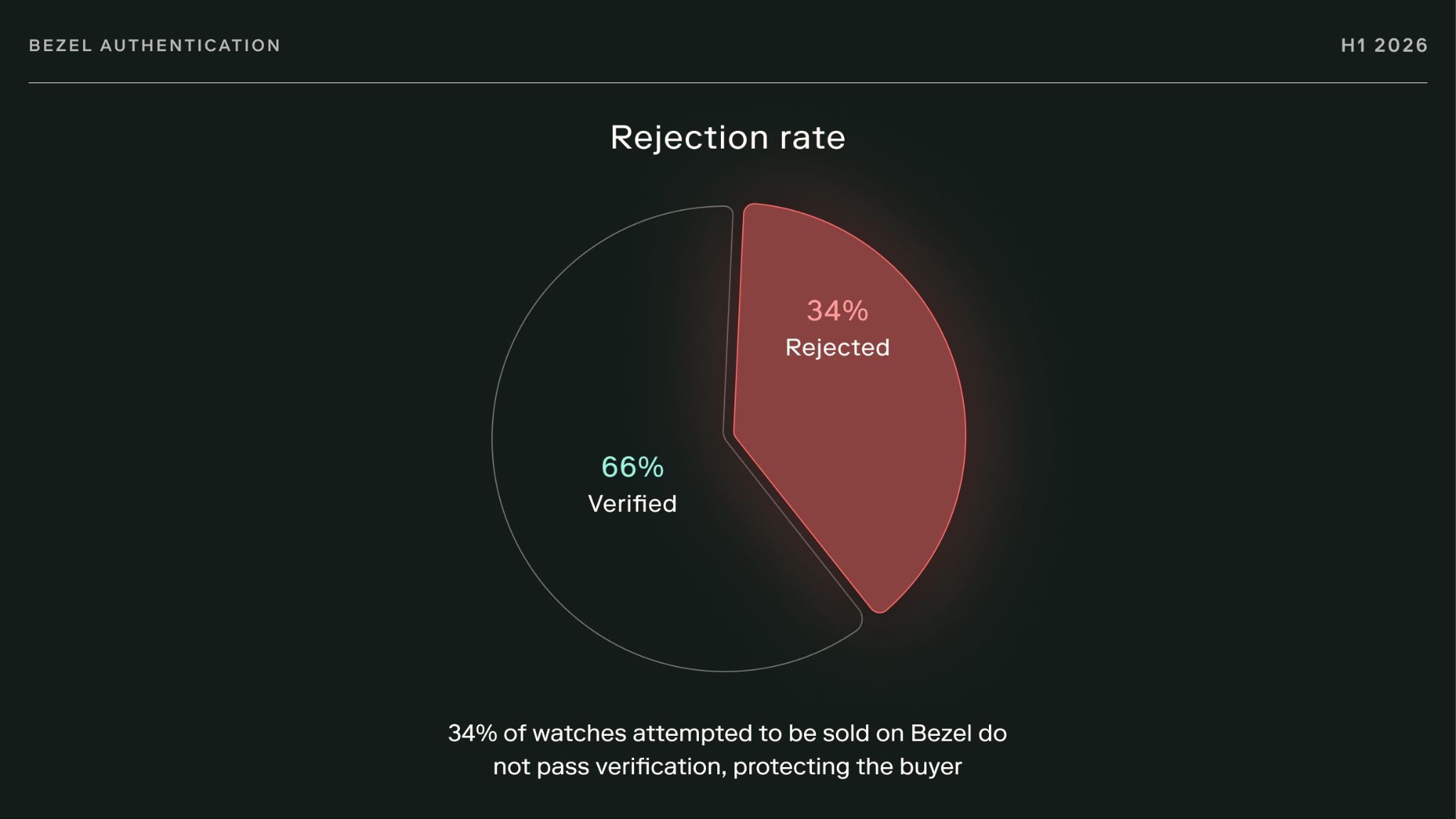
Before a sale on Bezel is final, the watch comes to our authentication team and is inspected in hand, the same multi-point process we run on every piece, whatever the brand, price, or origin. Across the first half of 2026, that work turned away 34% of the watches attempted to be sold, a rate that has tracked a tighter, faster market. The reasons were the familiar ones: outright counterfeits, parts that were not period-correct, conditions that did not match the listings, and mechanical faults found on the watchmaking bench. When we reject a watch, we cancel the sale before it ever reaches the buyer, and our Concierge Team then helps that buyer source a correct, fully authentic example to replace it.
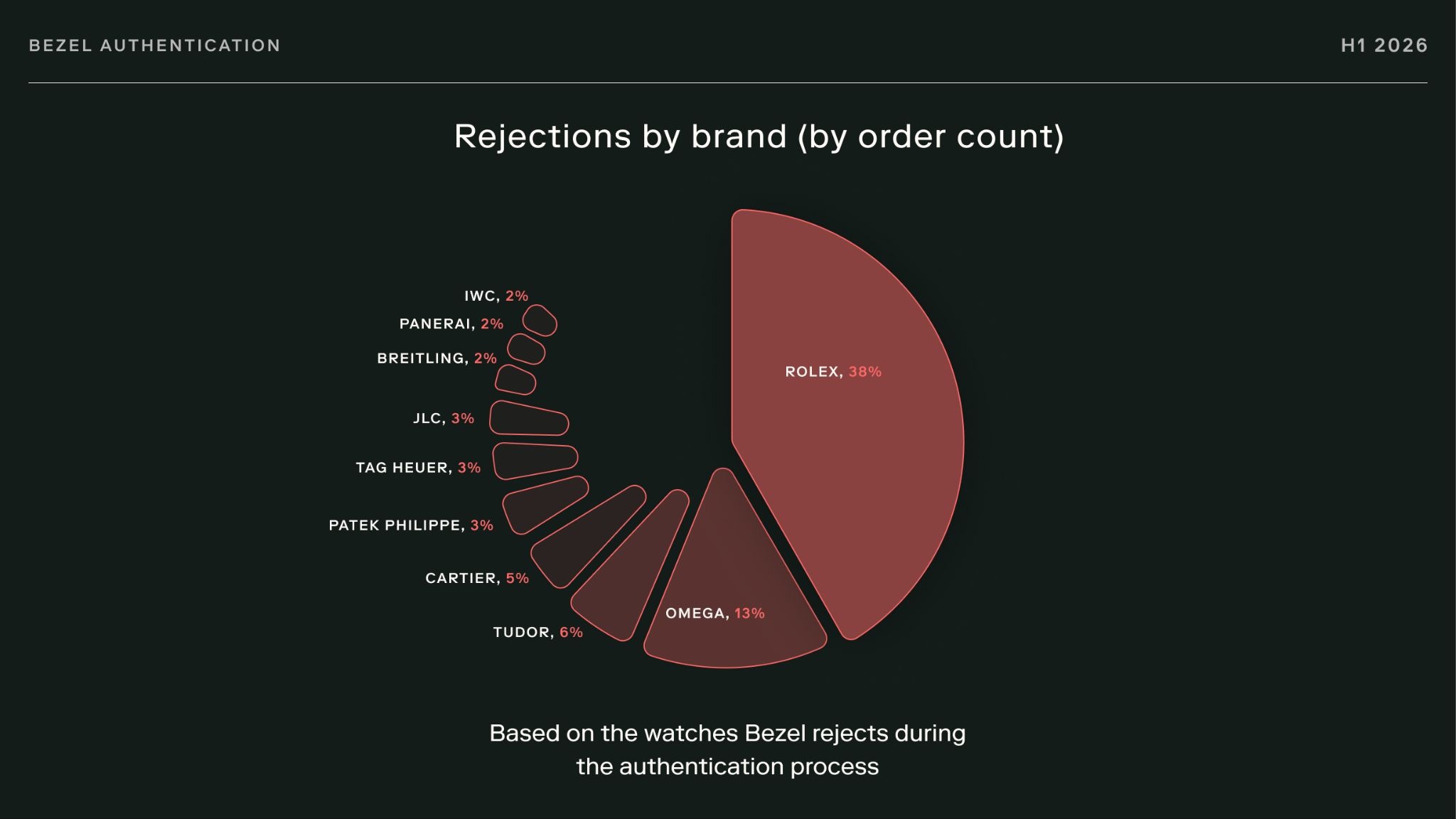
By count, rejections still tracked the market's shape. Rolex remained the most-rejected brand at 38%, which reflects how many Rolexes move on the secondary market and the incentive that creates to fake them. Omega followed at 13%, Tudor at 6%, and Cartier at 5%. Watches from outside the top ten brands accounted for 23% of rejections. Authentication risk reaches well beyond the names everyone is watching.
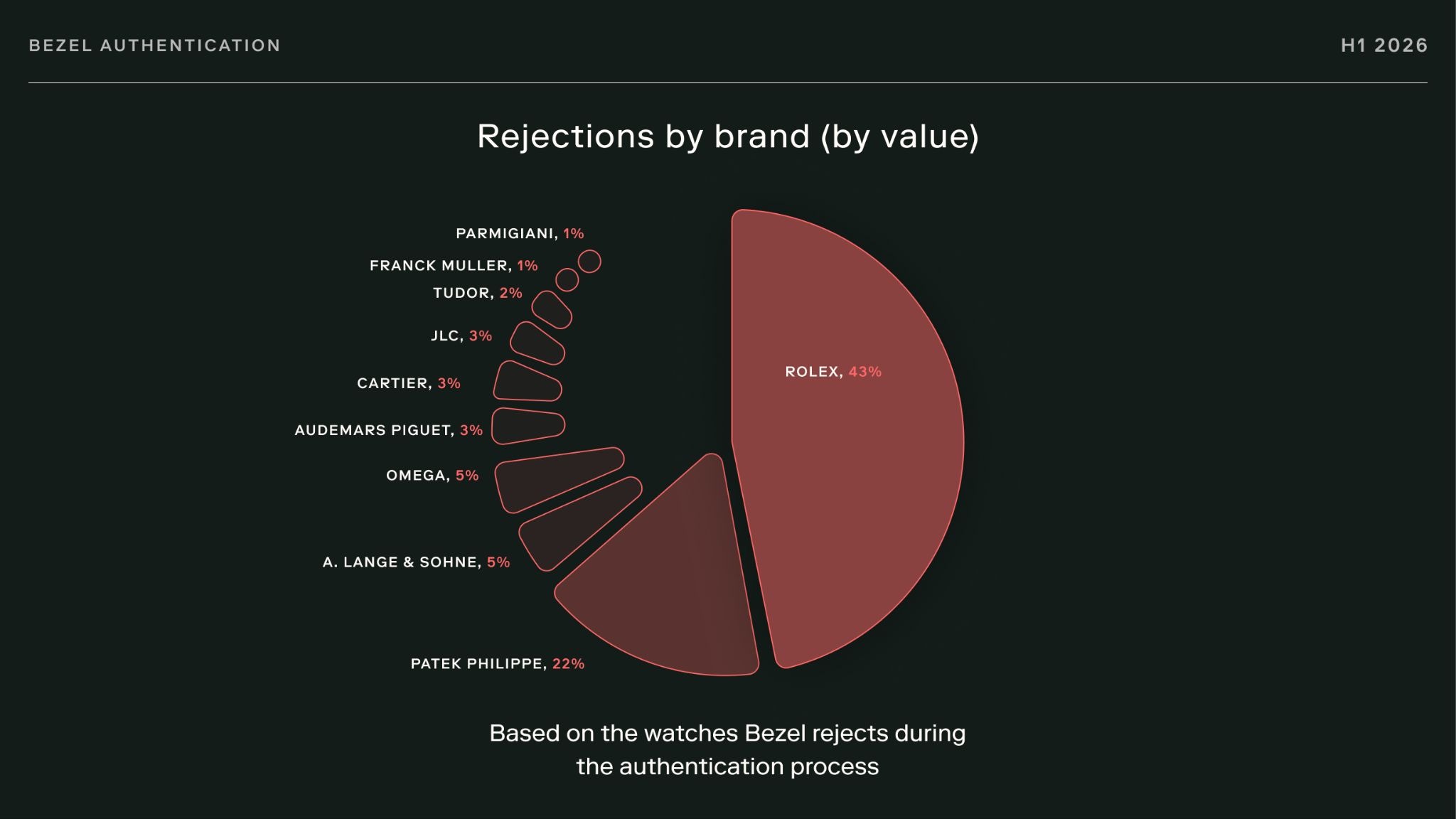
By value, the same rejections tell a sharper story, and it moves upmarket fast. Rolex accounts for 43% of rejected value, roughly its share by count. Patek Philippe is where the gap opens: it sits at 3% of rejections by count but 22% by value. A. Lange & Söhne, absent from the ten most-rejected brands by count, makes up 5% of rejected value on its own. Each of those high-end shares comes from only a handful of watches, so the exact percentages move easily, though the direction does not. Price is not protection here.
"The value lens is the one most people miss. By count, Rolex leads and probably always will. But the watches that can really hurt a buyer are the ultra-high-end pieces, where one bad example carries a six-figure risk." - Ryan Chong, Chief Marketplace Officer

A white-gold Aquanaut Flyback Chronograph, reference 5968G-001, sold through Bezel and went to our authentication team like every other watch. This sought-after modern Patek that trades around $140,000, and on the bench it checked out completely. Every component was right. The watch was genuine.
Part of our process runs a watch's identifying details against the largest international database of lost and stolen watches, and within hours of this one reaching us, the search returned a match. The Aquanaut had been reported stolen. It was taken from its owner's wrist as they left a shop in Ibiza in late September 2025, a police report was filed, and the watch was logged in the registry where we found it.
We stopped the transaction at once, pulled the watch out of the normal workflow, and held it securely while we determined whether the police case, any insurance claim, or any recovery effort was still active.
There was a second problem in the box. The watch arrived with a Certificate of Origin, but it was a forgery. The printing quality and the paper stock were both wrong, and the buyer details recorded on it didn’t match those of the original owner. Papers like these are often taken as proof of a watch's history, which is exactly why we authenticate accompanying documents along with the watch.
The seller had no connection to the theft and showed no sign of any wrongdoing, which is how these cases usually look. A watch is small and easily moved, and a stolen one can pass through several honest hands before it resurfaces, by which point whoever holds it has no idea what they’re holding.
This is the case that separates authenticity from provenance. The watch was genuine. That was never the problem. A real watch can still carry legal, financial, and ownership risks that have nothing to do with whether it is a fake, and catching those is as much a part of authentication as spotting a counterfeit. The watch was never shipped to the buyer, and our concierge team helped them source a clean example with an ownership history we could stand behind in its place. The full account is on the Bezel Journal.

This one arrived the way the convincing fakes usually do, quietly. An IWC Ingenieur Automatic 40, reference IW328904, a watch that trades around $13,000, listed by a professional seller who regularly sells a substantial amount of inventory. Nothing about it announced itself. A high-volume seller works fast by necessity, with a lot of watches to move and sales to close, and a good counterfeit is built precisely to survive that kind of quick once-over. This is the whole reason every watch on Bezel goes through the same in-house authentication, no matter who’s selling it, and under that closer look the Ingenieur started to come apart.
The first thing our authenticators caught was on the dial, under magnification. The printing showed a faint crudeness, with the edges of some lettering bleeding past where they should have stopped, unlike the genuine examples the team had handled prior. The bracelet gave up the second tell. The quick-release links and the micro-adjustment clasp both felt stiff in a way they should not, rigid and short of the finishing that makes a real IWC clasp operate cleanly. Two red flags were enough to take the watch apart.
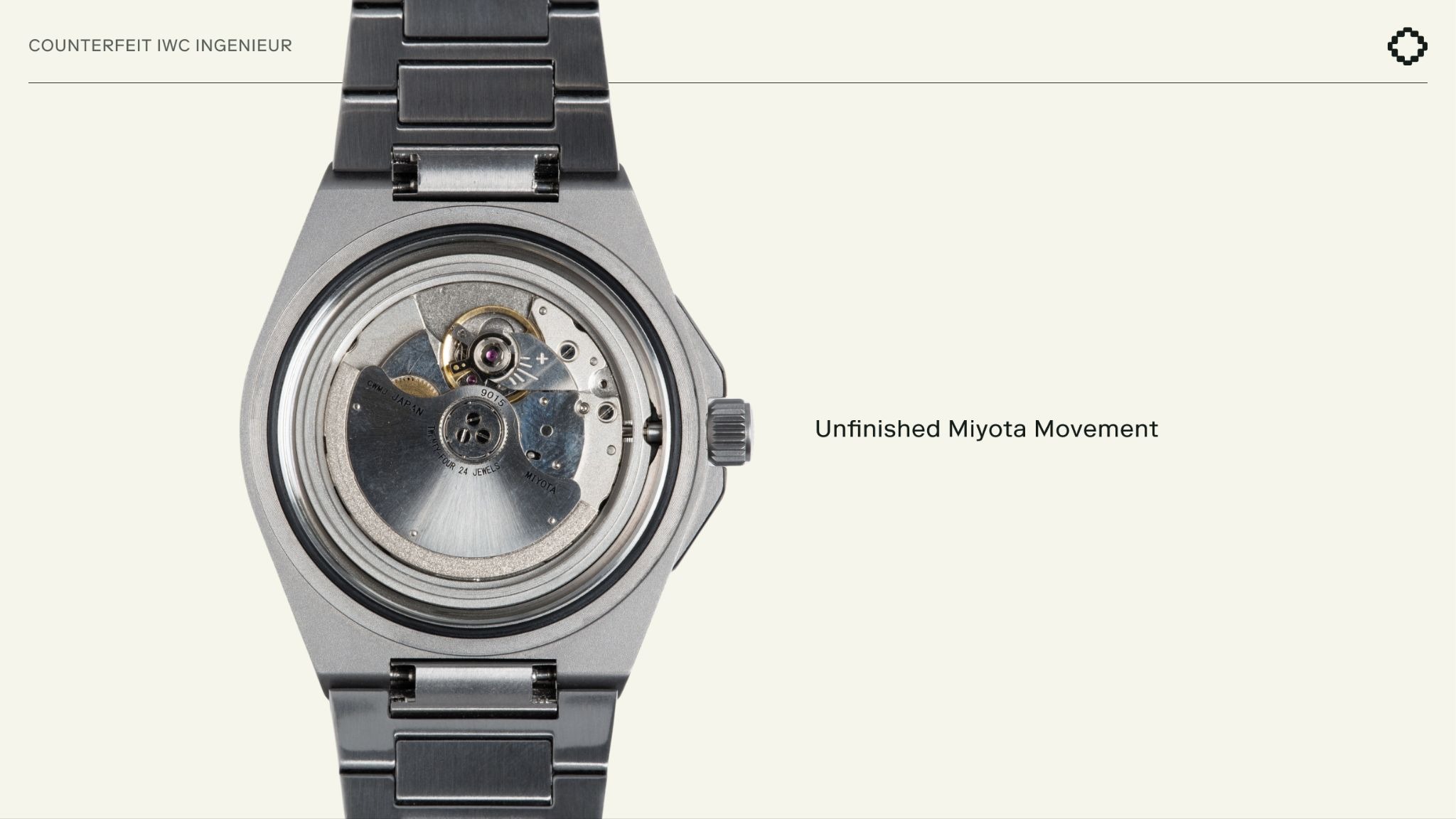
With the caseback off, the question was settled. While a genuine Ingenieur Automatic 40 carries IWC's caliber 32111, a five-day automatic, this one ran an unfinished Miyota movement. Miyota makes a perfectly good movement, dependable and widely used, but it belongs in watches a fraction of this one's price and nowhere near an IWC. It was ultimately counterfeit to its core, which was plainly visible the moment the back came off.
A fake at this level is the kind that slips through when watches move quickly, which is exactly the gap our process is built to close. We reversed the sale, made the buyer whole, and ensured the counterfeit did not go back into circulation. Our concierge team then helped the buyer track down a genuine Ingenieur, the watch they had wanted from the start. We walk through all three tells on the Bezel Journal.
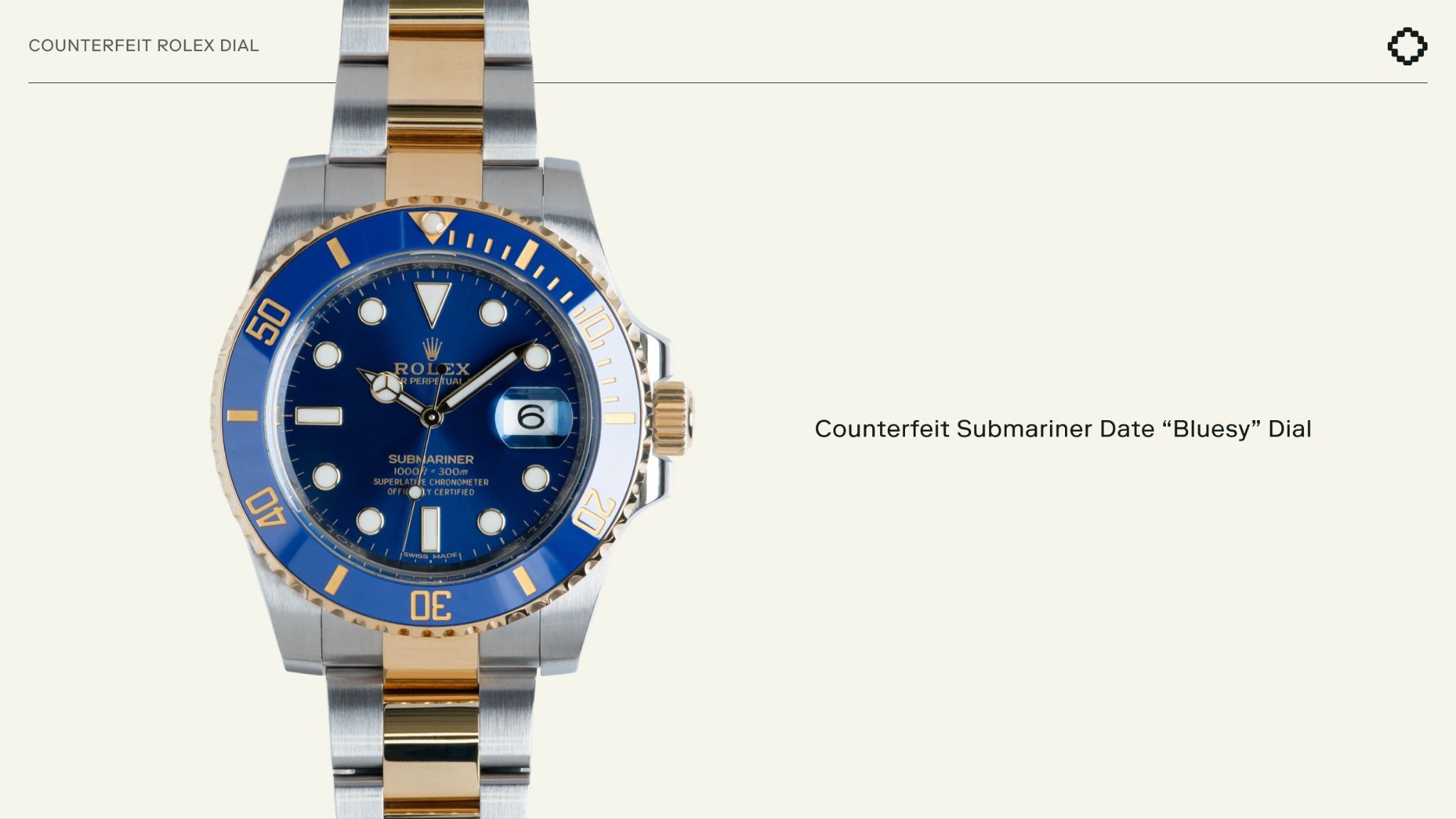
A Submariner Date "Bluesy," reference 116613LB, sold on Bezel and came in for authentication like everything else we handle. It’s one of the most recognizable modern Rolexes, a two-tone diver with a blue sunburst dial and a matching blue ceramic bezel, and it trades around $14,000. The case, the bracelet, and the movement all matched the reference, and nothing in the overall build asked for a second look.

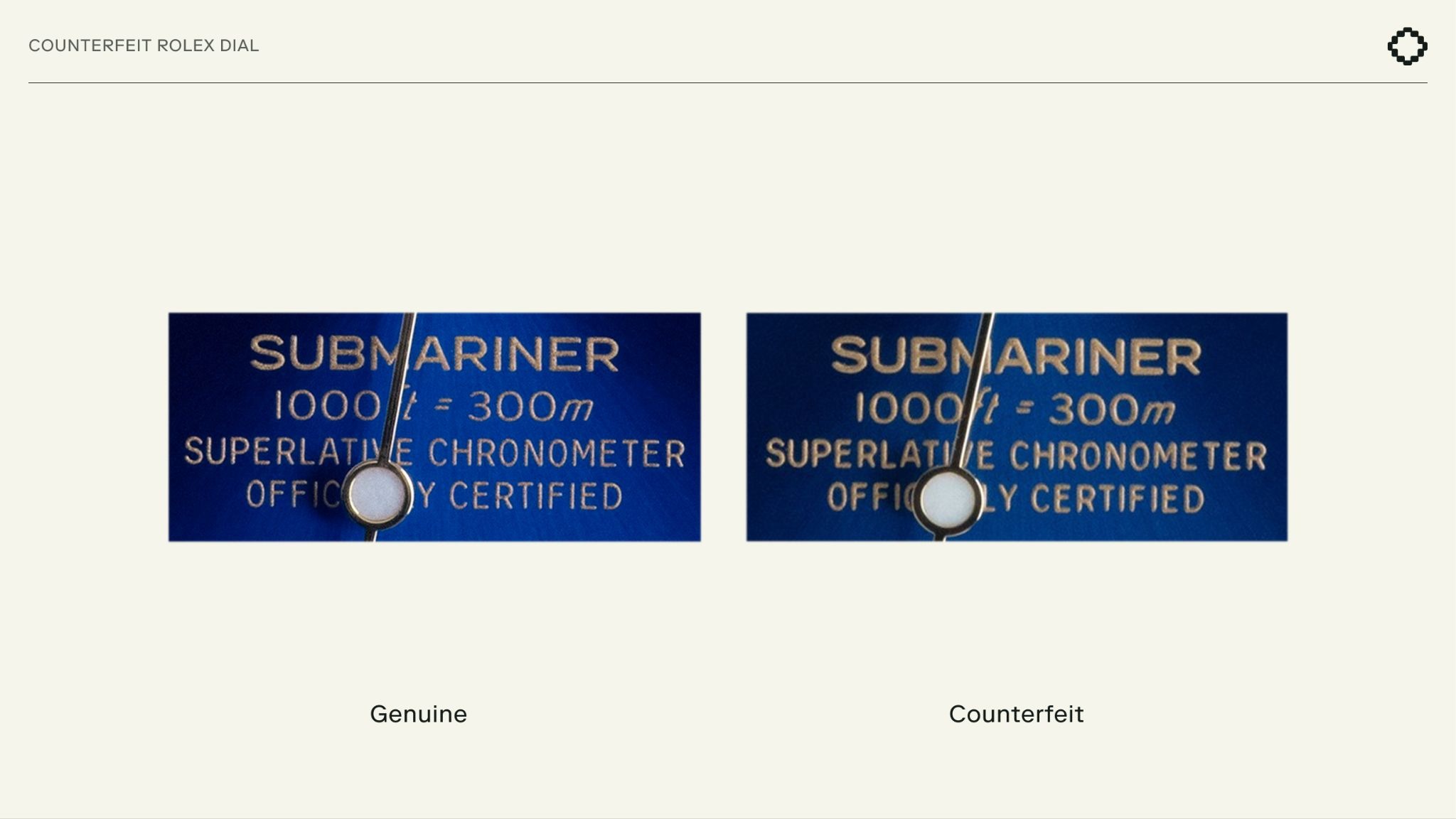
The dial, however, did. At a glance it read correct, the right shade of blue, the markers set where they belong, and the layout matching the production period. Under magnification the printing told a different story. The lettering sat heavier than it does on verified examples from the same era. It was subtle, and exactly the kind of small deviation that’s easy to wave off unless you have handled enough of these to feel it.
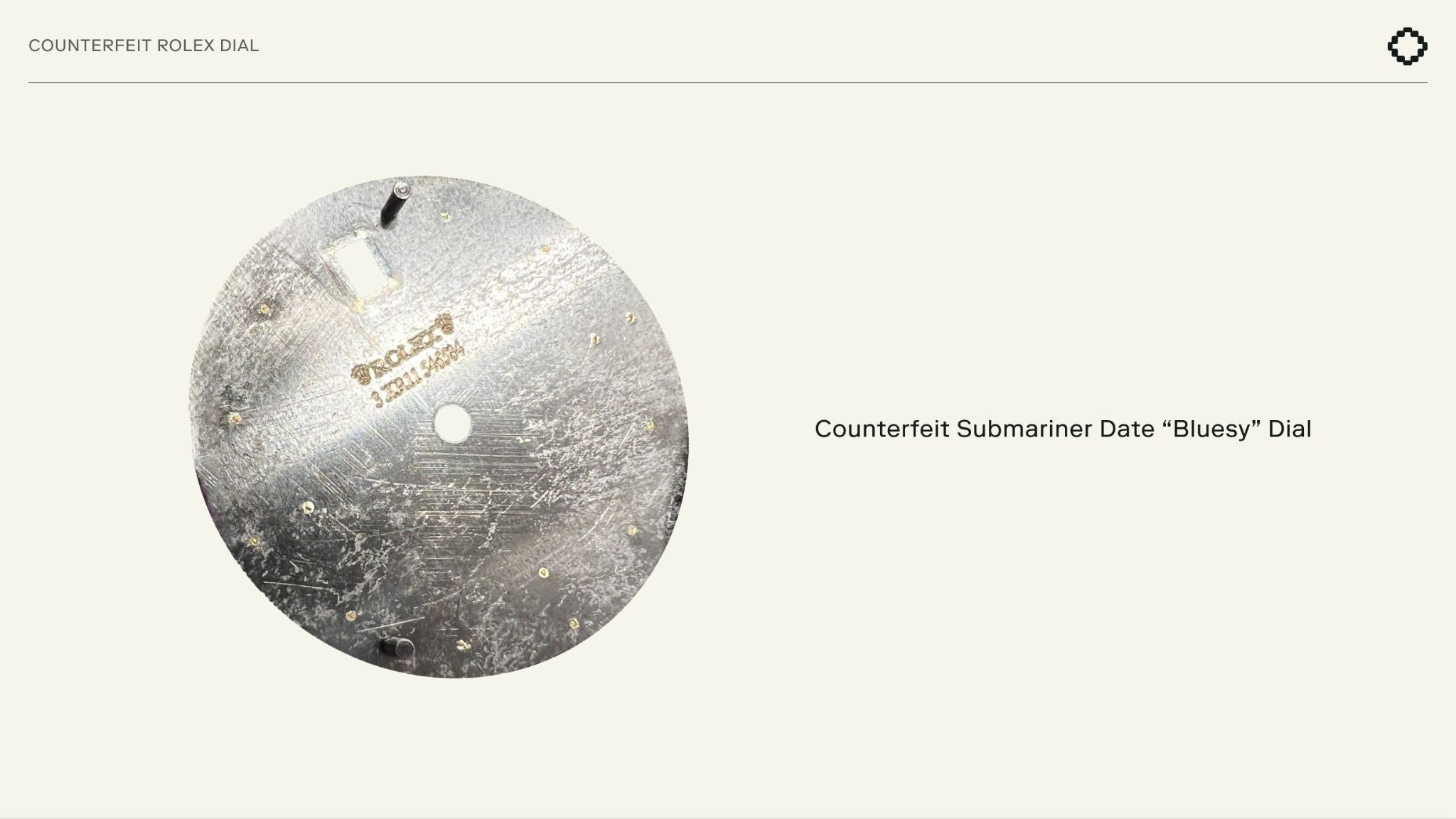
That was a question rather than a verdict, so it went to the next layer of our process, our in-house watchmakers, who took the dial off the movement to read it from behind. Genuine Rolex dials from this period are anodized and carry specific engravings on the reverse, and this one carried neither. As a result, we could confidently conclude that the watch was authentic, but the dial was not.
When a real Rolex is fitted with a dial that never came from Rolex, the gap does more damage than it first appears. On the secondary market a replaced dial pulls down what a Submariner like this is worth even when everything else is right, and it follows the watch into every future sale. Service is the harder problem, since Rolex will not work on a watch that carries non-genuine parts, which leaves the owner facing a refused service or a dial swap at their own expense before the brand will touch it. We stopped the sale before it closed, made the buyer whole, and the watch was never sent on. From there, our concierge team then helped the buyer source a correct, all original and fully authentic example in its place. Read the full story on the Bezel Journal.
Bezel reads demand three ways. Purchases are the watches clients bought outright on the platform. Wants are the references a client follows, so the platform can flag a new listing or a price move - the tracked interest that appears in the figures below. Owned watches are those registered in a Bezel collection, a personal record that also feeds collection tracking and, where a client opts in, Bezel Insurance. Through the first half of 2026, the three tracked each other closely, and the story sat in the places they pulled apart.

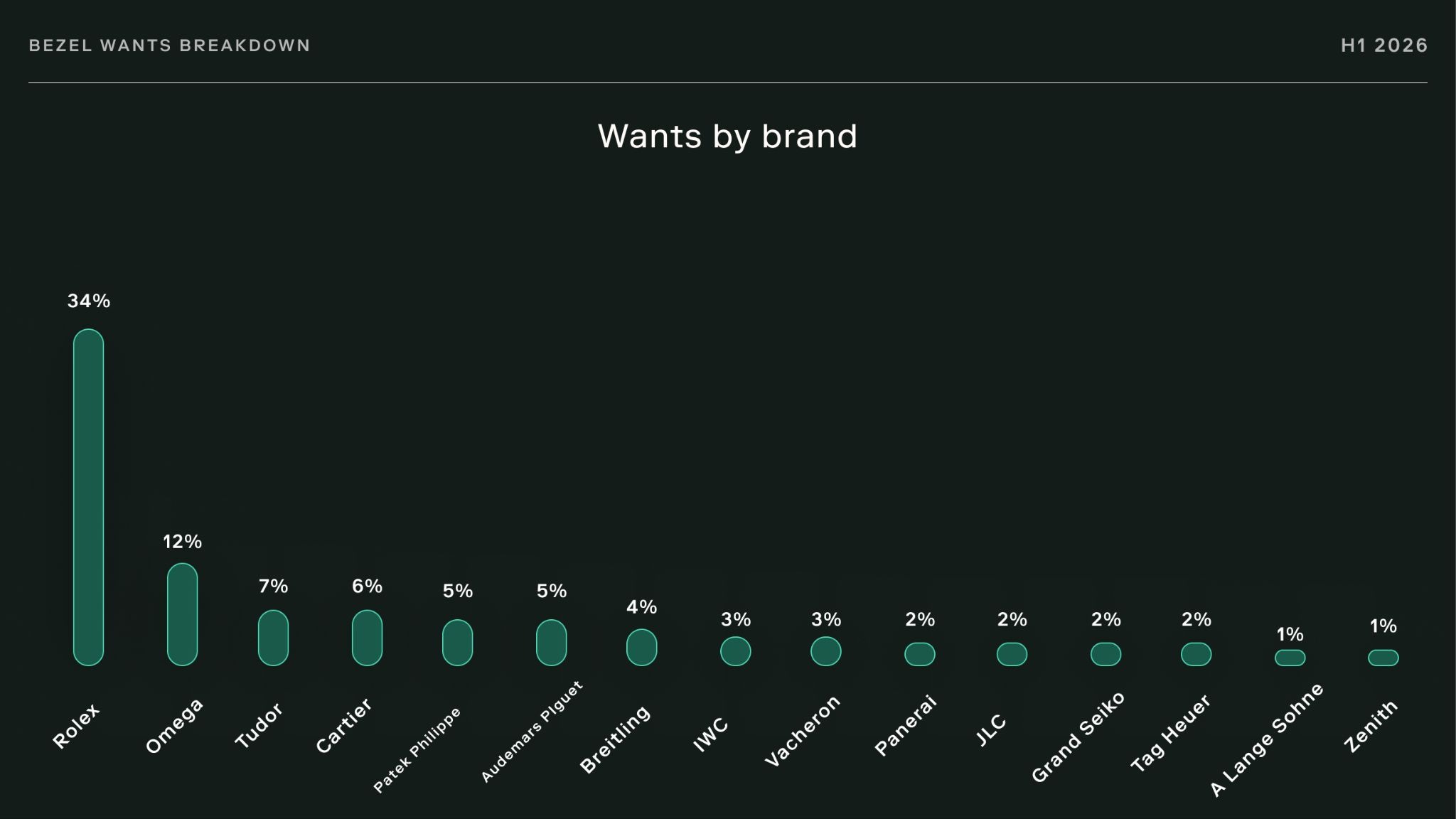

Rolex led all three lenses, with 34% of Wants, 28% of orders, and 35% of owned watches: aspired to a little beyond what people actually buy, and held in more collections than anything else on the platform. Tudor was the standout. It drew 7% of Wants but took 14% of orders, finishing second by sales ahead of Omega and reaching clients who buy it without necessarily chasing it first. Omega sat just behind on every measure.
Higher up the price ladder, the pattern inverted. Patek Philippe and Audemars Piguet each pulled 5% of tracked interest and 2% of orders, wanted far more than bought, the dream-tier shape that turns up every cycle. The long tail did the opposite: brands outside the top ten drew 19% of Wants but 23% of orders, a sign that buyers are increasingly willing to close on watches they were not already following. Auctions are a big part of why. They accounted for 45% of orders over the first half of 2026, and they’re where much of that discovery happens. When watches are introduced to buyers who weren’t previously looking for them, the countdown of a live auction often turns a first look into a purchase.
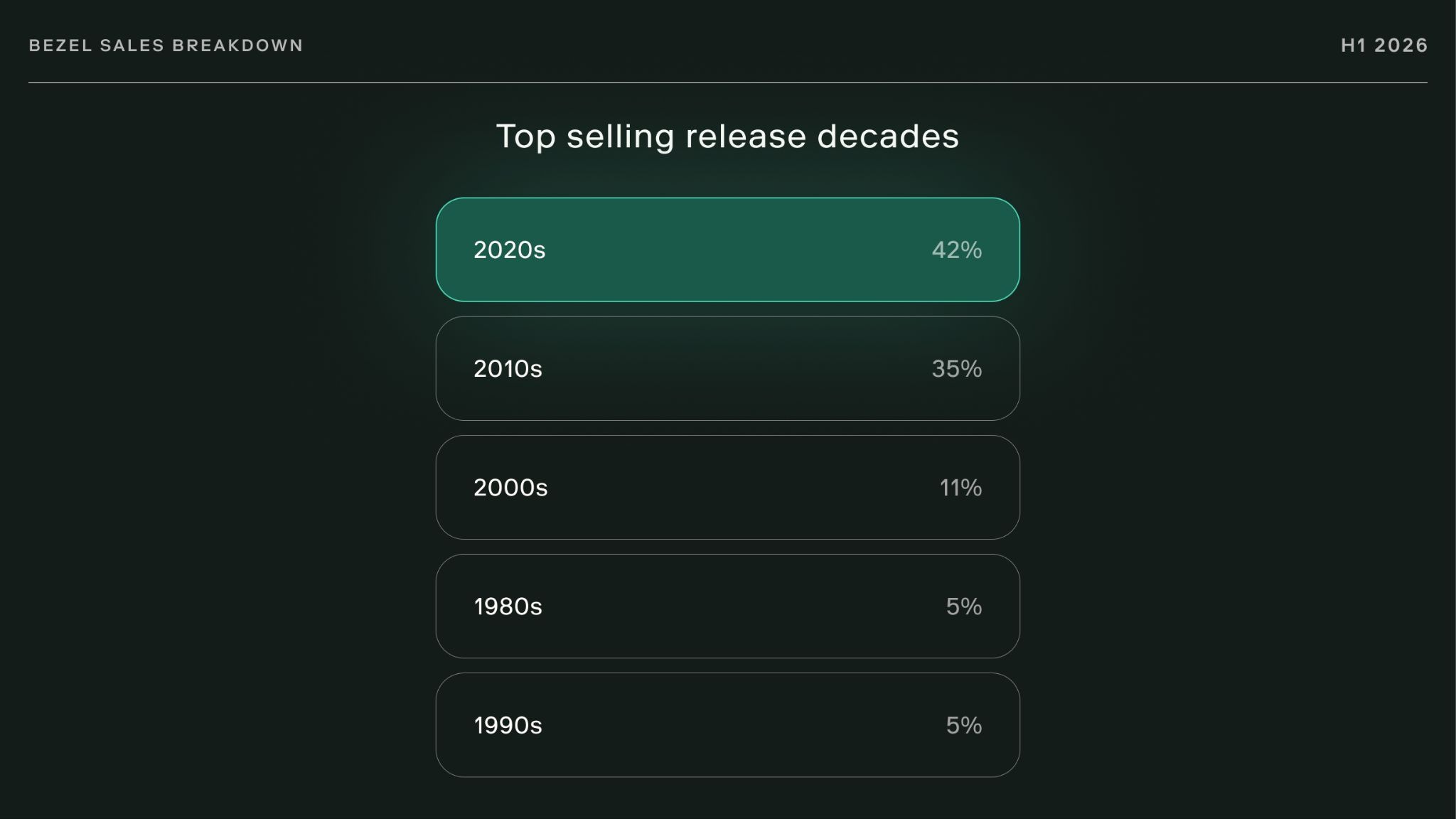
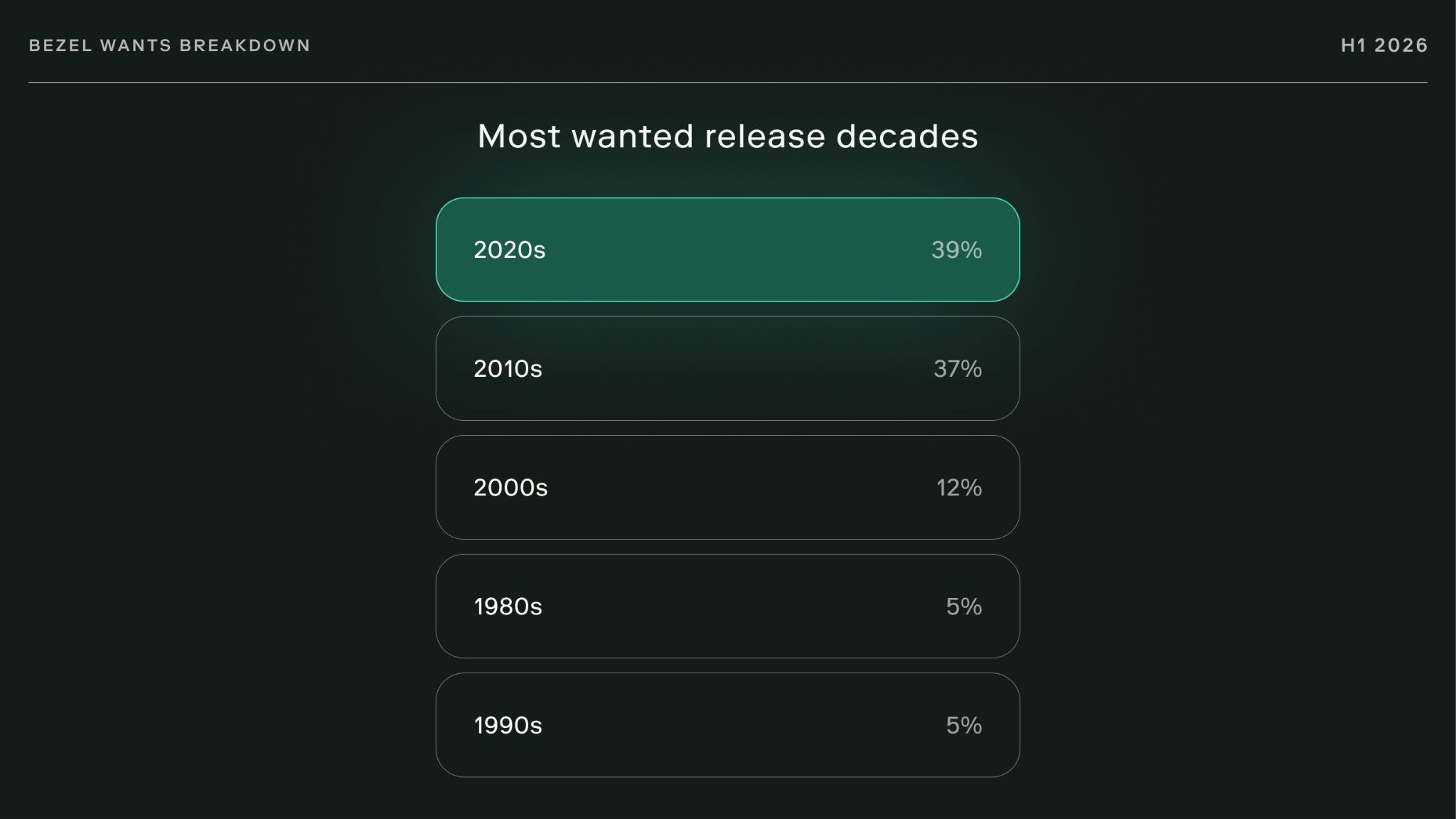
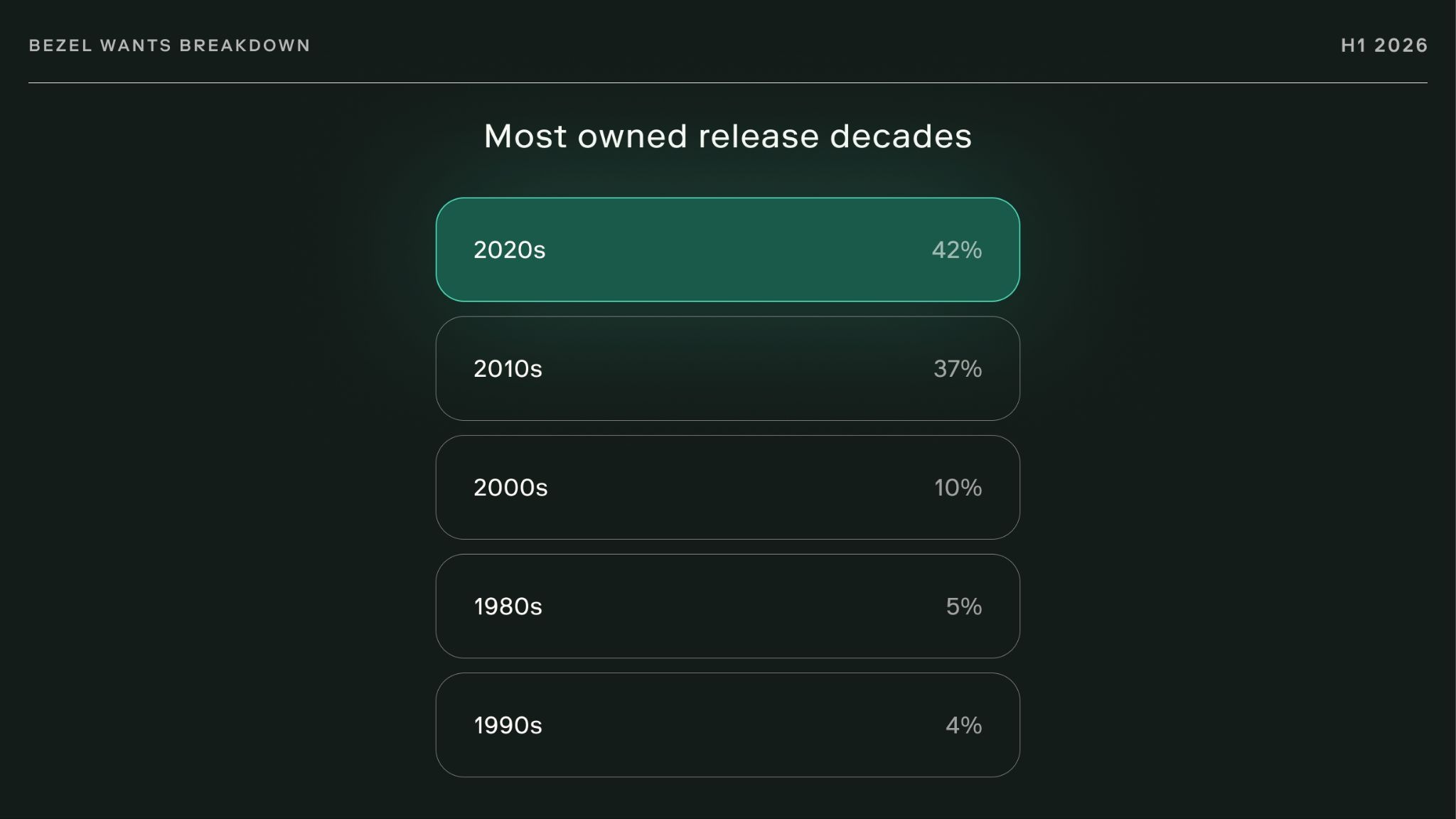
Current-production watches now lead outright. References from the 2020s accounted for 42% of orders, ahead of the 2010s at 35%, and together the two decades accounted for around three-quarters of activity across every measure. The 2000s held a double-digit slice, and anything older landed in low single digits, in keeping with a marketplace built around modern and neo-vintage watches.
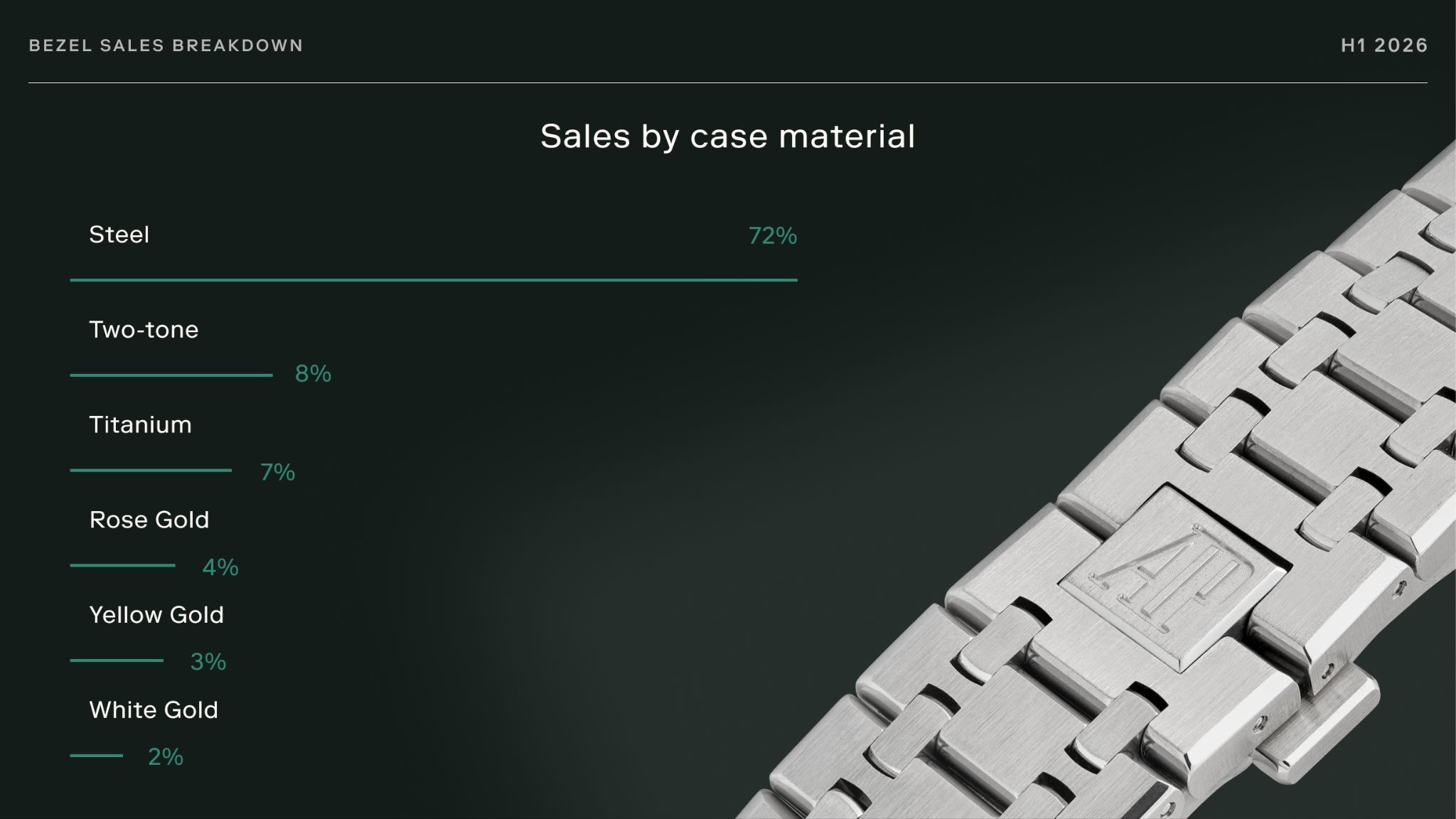
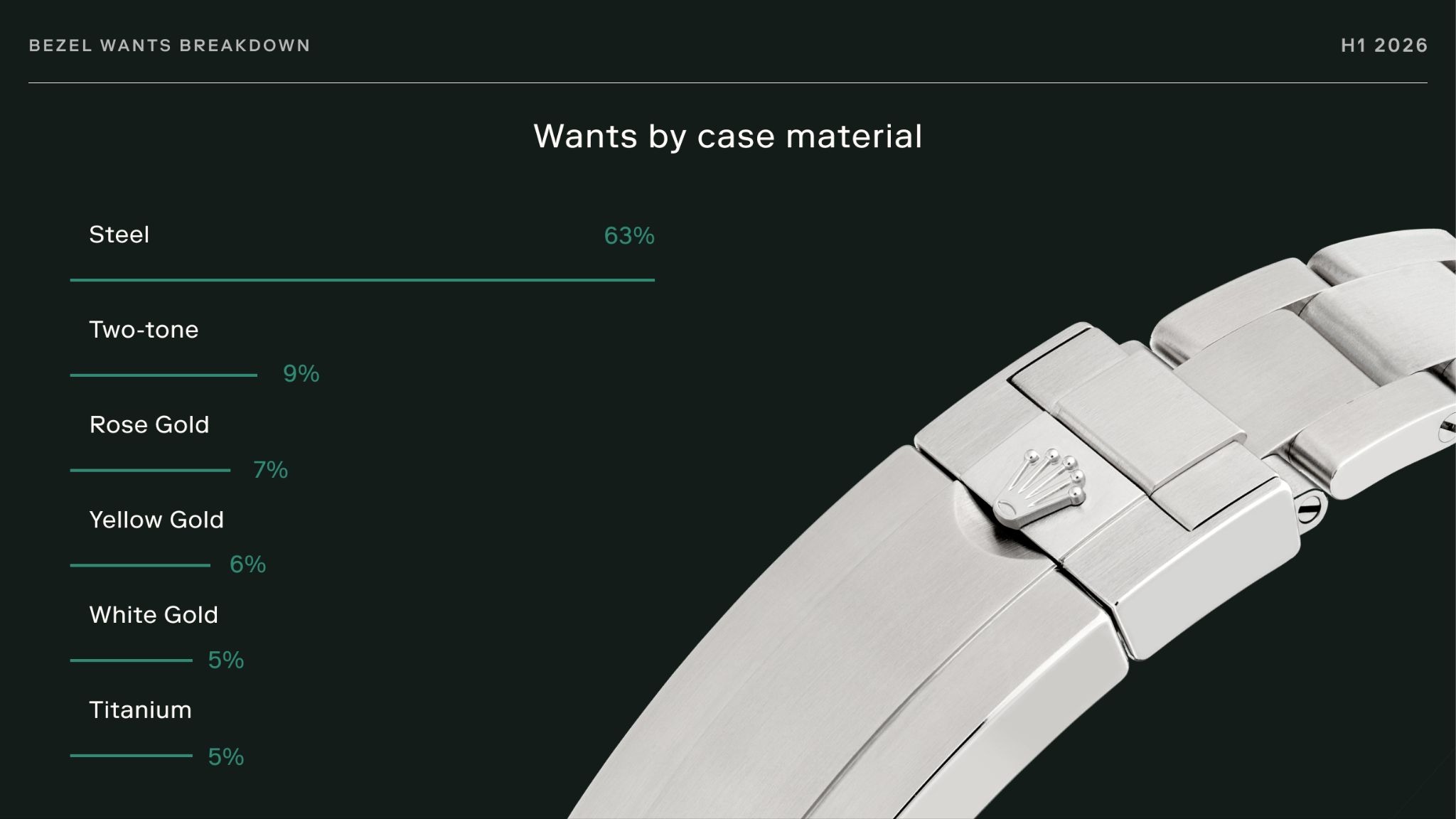

Material is where the year's macro story showed up in behavior. Steel accounted for 61% of Wants but 72% of orders and 73% of owned watches, converting from want to purchase more strongly than anything else. Precious metals ran the other way. Rose gold drew 8% of Wants and 3% of orders, while yellow and white gold each pulled 6% of Wants and 2% of orders, representing the aspirational end of the market. Gold had climbed through late 2025 to a record high early in 2026 and eased back over the first half of 2026 while staying well above prior years, and brands adjusted the pricing of their gold references around that run while leaving steel references largely unchanged, so the gap points to cost rather than taste. Titanium did the quiet reverse, taking a slightly larger share of orders than of interest; the lightweight, utilitarian pick that finds buyers without being chased.


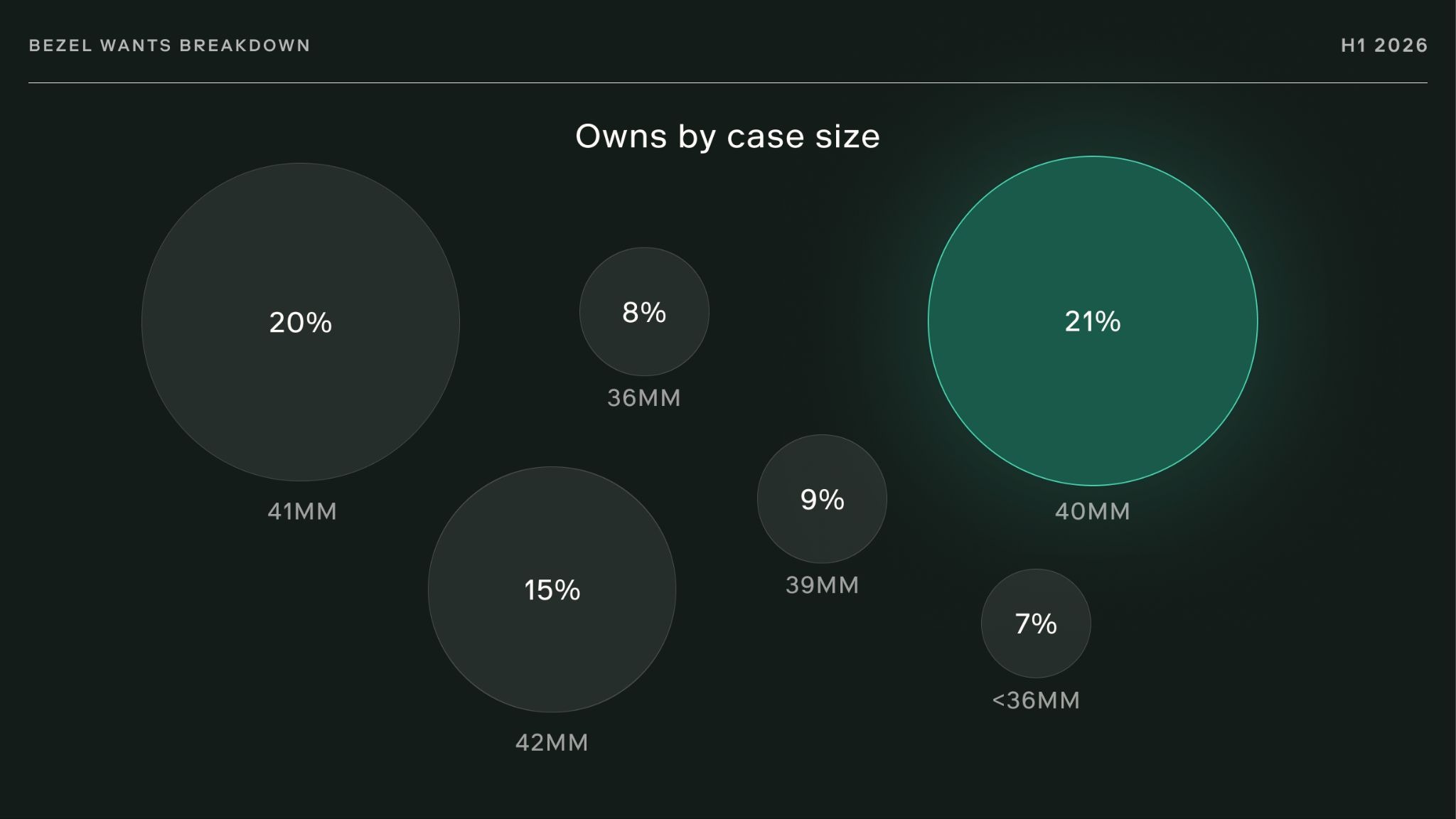
The 40mm and 41mm bands formed the core of both interest and orders, with the broad middle from 39mm out past 42mm taking most of the rest. The larger sizes converted a touch above their share of interest, a small lean toward presence on the wrist. Non-circular shapes held a narrow, consistent place on the platform.
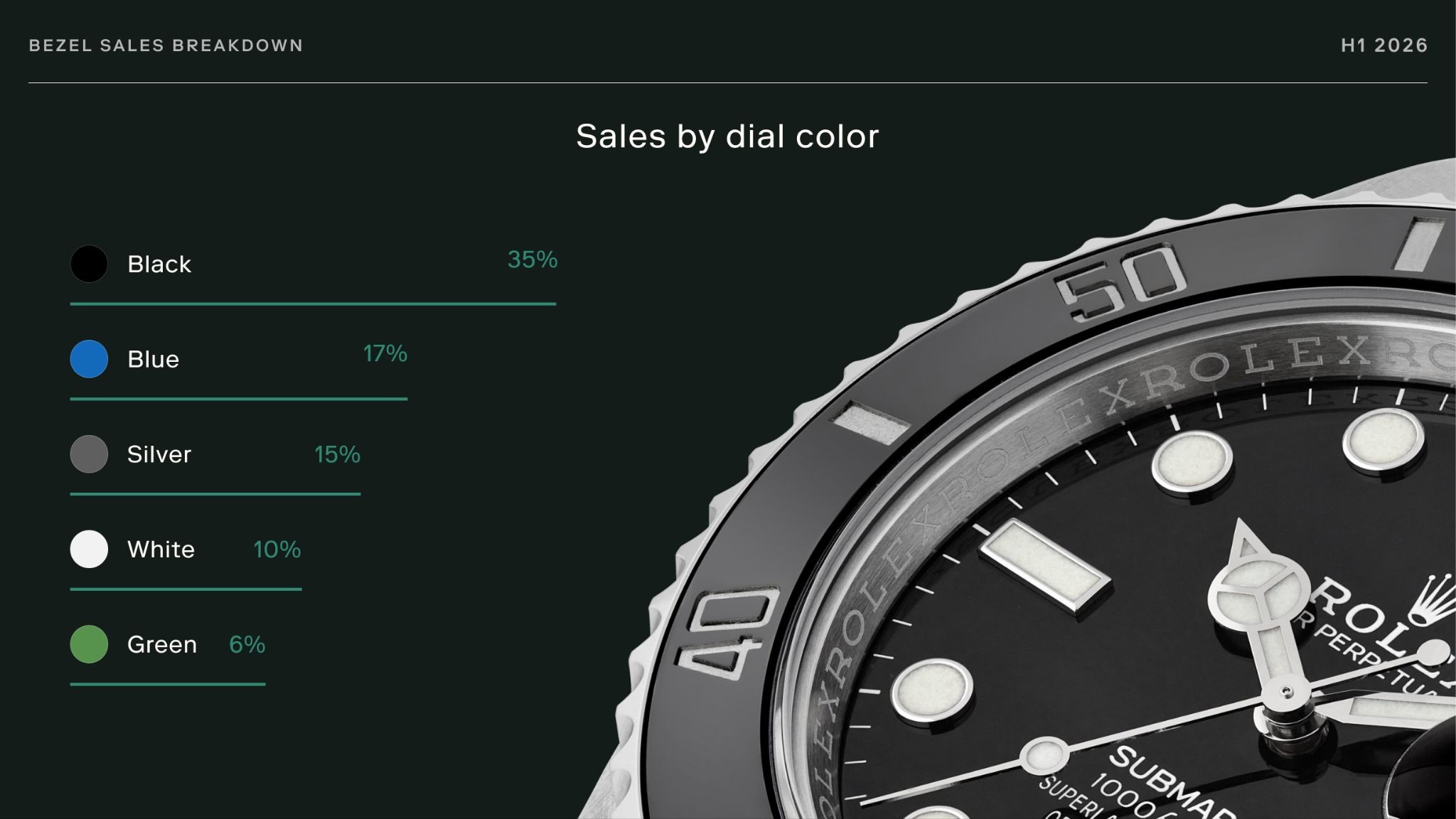
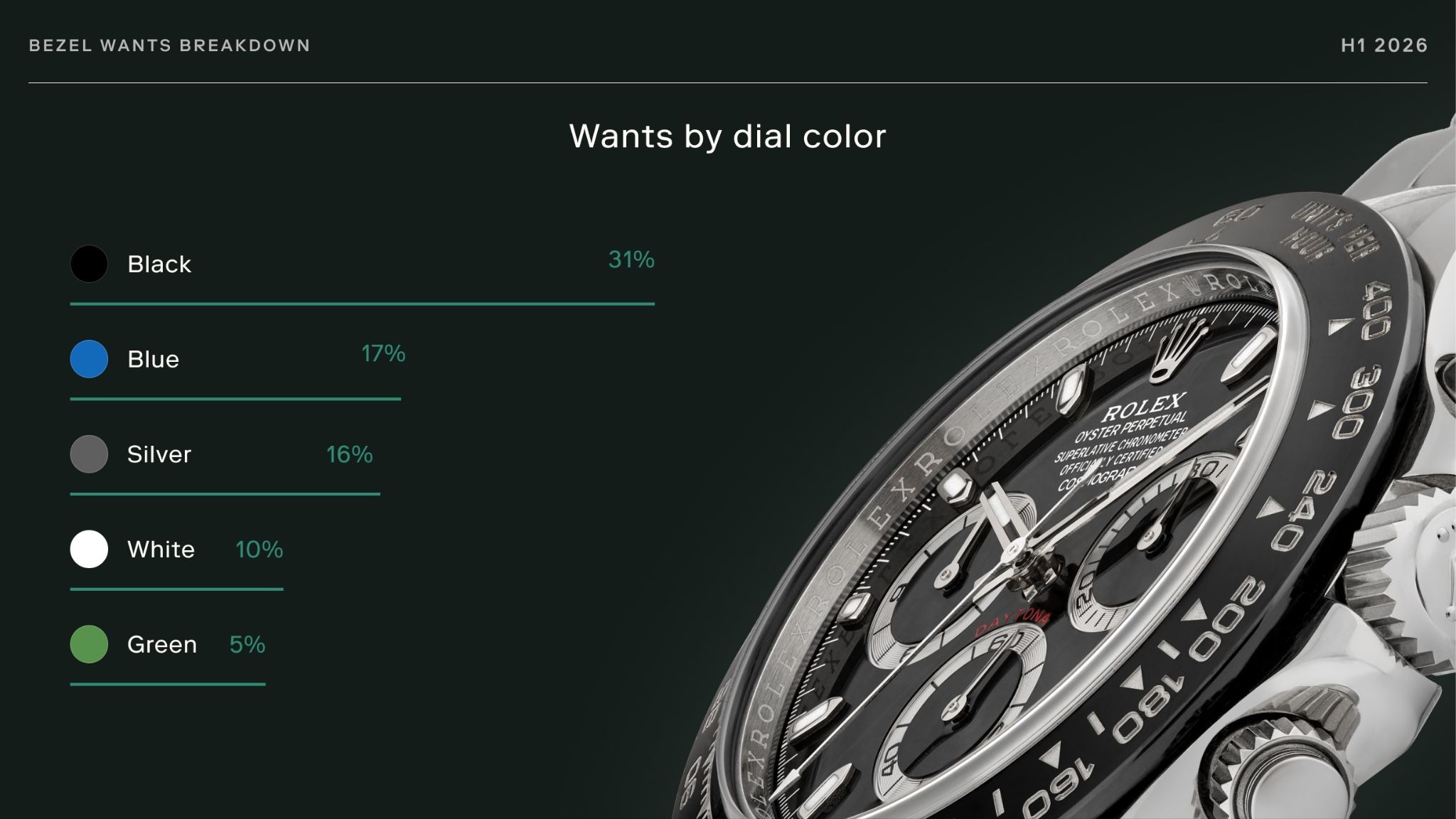
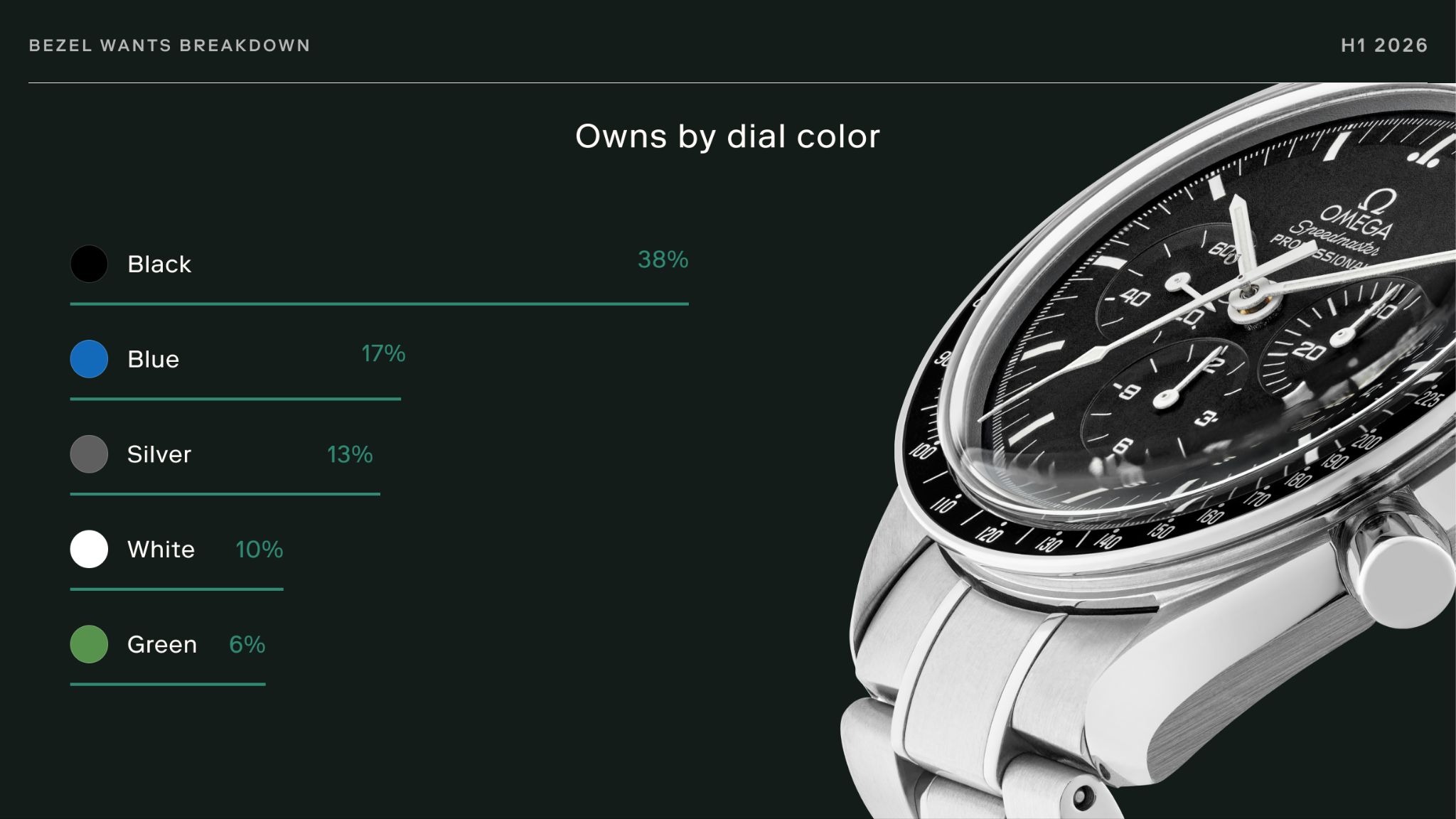
Black, blue, and silver led every measure, with black alone taking 35% of orders and the more adventurous colors confined to their usual narrow band. Across brand, decade, material, size, and color, the pattern holds: the market conditions this half moved far more than the watches clients actually reached for.
Over the first half of 2026, the conditions Bezel operates in were set less by demand, which held, than by cost and supply. Import duties on Swiss watches settled into a single rate after the swings of late 2025, steady enough for brands and dealers to plan against. The footing under that rate shifted again near the end of the period. A court challenge knocked down the original basis for the tariffs, and the replacement was set to expire within months, leaving importers paying the same rate while facing a fresh question about what came next. For most of the first half of 2026, though, the heavier pressure came from metal.
Gold climbed through late 2025 to a record high in early 2026, then eased back over the half while holding well above prior years, and the industry repriced around that run. Brands lifted prices on gold and two-tone references while largely protecting steel, resetting the cost of replacing a precious-metal watch at retail. That carried into the secondary market, where the gap between retail and resale narrowed. A floor of metal value sits beneath gold pieces, though what they actually sell for is set by desirability, not weight.
The clearer tailwind ran underneath all of it. A watch already in the United States can change hands without crossing a border again, so the import duties weighing on new supply never touch it, and that asymmetry pulled strength into the pre-owned market. Our move past a billion dollars in listings sits squarely in that shift. We grew into a market that was rewarding watches already in the country, and the behavior on the platform fits the same pressure: steel converting above its Want share, gold remaining aspirational.
"The watches holding best right now are the ones already here, in steel, in the configurations people actually wear. Tariffs and gold reset the cost of everything new, and that moved a lot of attention onto the pre-owned market." - Ryan Chong, Chief Marketplace Officer
Watches have never been a bigger part of pop culture than they are now. From awards season to the Met Gala, the watch became as deliberate a styling choice as the outfit, something stylists now build into the look rather than leave to chance. The Met Gala made the point loudest, under a theme that framed fashion itself as art. The grails and showpieces drew the cameras: a Patek Philippe grand complication on Jay-Z, a diamond-covered Jacob & Co. on Dwayne Johnson. The wrists collectors actually talked about were quieter and harder to find: Mark Zuckerberg in a handmade George Daniels Anniversary watch, which caught the watch world off guard, and Rami Malek in a vintage Cartier Crash. The flex that landed was knowledge, not price.
Underneath the spectacle, the serious-collector move of the period was independents. A younger, online-educated set of buyers has been rewarding small makers for the watchmaking itself, and the names at the top of that world, F.P. Journe, Akrivia, Philippe Dufour, traded at the strongest levels they’ve seen. The trend press spent the first half of 2026 pushing smaller cases and louder dials, while our buyers kept reaching for 40-41mm steel in black, blue, and silver, a reminder that what gets styled and what gets bought are not always the same thing. Where our data did move with the culture was brand. Even well outside the top ten, lesser-known makers took a larger share of orders than of tracked interest, recognition spreading past the handful of names that used to define the whole conversation.
The first half of 2026 pushed active listings past a billion dollars, and what I keep coming back to is the 34% we turned away. In a market this tight, holding that line is the work we care about most.
For the back half of the year, we’ve got exciting things in the works to further improve the experience of buying, selling, and owning luxury watches. We’ll keep sharing what we see, with the fuller picture coming in our full-year report. As always, thank you for reading, and for continuing to trust Bezel with the watches you care about most.
Bezel is the top-rated marketplace for buying and selling luxury watches. We give you access to tens of thousands of the most collectible watches from the world's top professional sellers and private collectors. Every watch sold goes through our industry-leading in-house authentication process, so you can buy, sell, and bid with confidence.
Download the Bezel app on the iOS App Store or start searching for your next watch today at getbezel.com.
Bezel is available to download on the App Store now. Please reach out to our concierge team if there is anything we can help you with!

©2026 Bezel Inc.
All rights reserved.