
Watch insurance costs about 1% to 2% of value per year. Learn how to insure a watch, what a policy actually covers, and why homeowners coverage falls short.
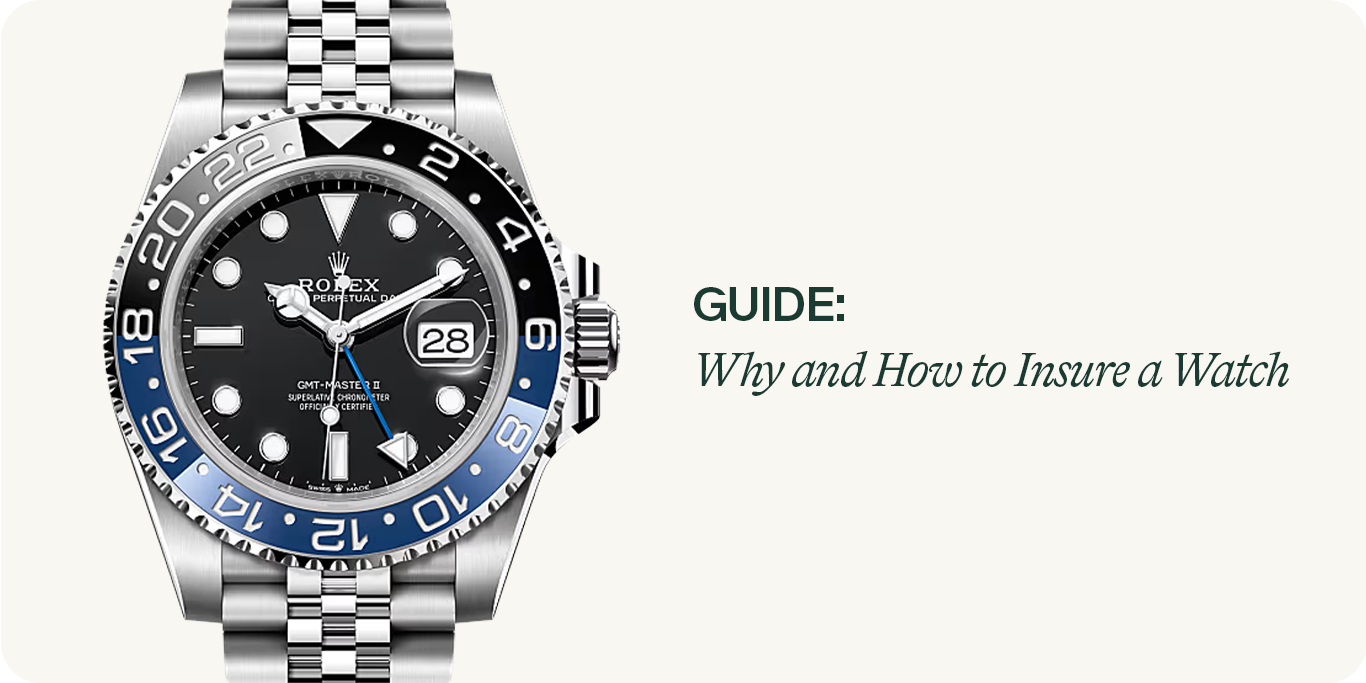
Insuring a luxury watch runs roughly 1% to 2% of its value per year, which lands at a few hundred dollars annually for most collectible references.
The cost is rarely what stops people. What stops them is the assumption that a homeowners or renters policy already handles it, and that assumption is close to always wrong.
The gap between what those policies actually cover and what a watch is worth is where most uninsured losses happen.
A standard homeowners or renters policy is built to protect a house and the ordinary contents of it, so watches and jewelry sit under a sublimit instead of under the full coverage amount.
That sublimit is a flat cap on the whole category, often a few thousand dollars, and in most policies it applies to everything you own in that category rather than to each piece. One steel sports watch clears it.
Pull your declarations page, find the line for jewelry and watches, and read the number before you assume anything else about it, because it’s almost always lower than owners expect and it hasn’t moved in years.
Two pieces of standard policy language do most of the remaining damage.
Theft, in the contractual sense, needs evidence that someone took it. A watch that merely isn’t where you left it, slipped off at a beach or gone from a hotel room with no sign of entry, falls into a separate category insurers call mysterious disappearance, and plenty of home policies exclude it outright.
Then there’s the deductible, which on a home policy typically runs into four figures and comes off the top of whatever you’re paid.
The quieter cost is the one watch owners find out about last. A jewelry claim sits on the same policy as your house, so filing one can raise what you pay to insure the building for years afterward.
Keeping watches on their own policy, which is what dedicated watch insurance does, keeps a watch loss from following you onto your home coverage.
A dedicated watch or valuables policy is written around the ways watches actually get lost, which is a different list from the ways houses get damaged. Collector coverage typically includes:
Many of these policies also carry no deductible at all, which is the sharpest single contrast with a rider bolted onto a home policy.
The exclusions are consistent from carrier to carrier, and they mostly trace the line between insurance and maintenance. Normal wear and tear isn’t covered, so a scratched crystal, a stretched bracelet, and a faded bezel stay your problem. That’s upkeep.
Mechanical failure falls to service and warranty coverage instead, and it’s worth knowing what a watch warranty covers before assuming the two overlap. Cosmetic damage you choose not to repair generally isn’t claimable either, and almost every provider excludes a watch placed in checked luggage.
Specifics vary, so read the policy language while nothing has gone wrong.
Expect roughly 1% to 2% of the insured value per year. On a $10,000 watch that’s about $100 to $200 annually. On a $30,000 piece it’s closer to $300 to $600, and the percentage tends to thin as value climbs, so a collection costs proportionally less to cover than the same watches would one at a time.
Geography does most of the work, since carriers price theft risk by location and collectors in dense metros pay more than those outside them. A safe and a monitored alarm pull the other way.
Travel pushes a rate back up, because a piece crossing borders every few months carries more exposure than one that spends its life between a wrist and a drawer. Every quote is priced off the application, so treat any published range as a starting point and not a price.
The premium on most collectible references lands under what a single service costs, which makes it an easier line item to defend at home than most things in this hobby.
A collector wearing a $16,000 watch daily for five years without coverage is risking the whole value of the watch to avoid something in the neighborhood of $1,000 in total premiums. Those are poor odds on an object that’s small, worn in public, and liquid enough that someone else has a use for it.
If you don’t have a current number for the reference, working out how much it’s worth on today’s market is the place to start.
You’re insuring replacement value, which is what a comparable example would cost you to buy today. That isn’t the retail price. It also isn’t what a dealer would pay you, a lower figure called fair market value.
Work from recent sold prices for the same reference in similar condition, with the same box and papers situation.
Most of this you should have anyway, starting with the purchase invoice, the reference and serial numbers, and clear photographs of the dial, caseback, bracelet, and clasp. Insurers commonly want those photos dated.
If you bought privately and don’t have paperwork you trust, confirming your watch is authentic is worth doing before you put a value on it. Keep copies in cloud storage instead of the drawer next to the watch, since a burglary takes the paperwork too.
Quoting a watch is a short process now, and collector-focused providers will price a piece from the reference, the value, and a few questions about how you store and wear it. Ask when coverage starts.
If you’re insuring something you’ve just bought, there’s a window while the watch is in transit, and you want to know whether it’s covered then or only once it’s on your wrist.
A policy set once and forgotten is the most common route to being underinsured. Values move. Revisit the insured figure as the market does, and add or remove pieces as you trade, since most collections turn over more than their owners expect.
Usually not, and this is where most published advice has fallen out of date. Collector-focused policies have largely dropped the formal appraisal requirement below a threshold, commonly around $100,000, and photographs plus a purchase invoice are enough to establish value.
Chubb’s collector program, which sits behind several of the watch-specific offerings on the market, works this way. Above that threshold, expect to supply an invoice or a recent appraisal.
When an appraisal is required, the type of appraisal does more work than the number on it. An insurance appraisal should state retail replacement value, which is what buying a comparable watch would actually cost you.
Fair market value, the figure used for estate and resale purposes, is lower, and an appraiser who hasn’t been told which document you need will often reach for the wrong one. Say which one you need, because that mistake leaves you covered for less than the watch is worth and nobody catches it until a claim.
An appraisal more than two or three years old should be treated as stale. Values moved hard between 2020 and 2022 and then corrected, so a piece insured against a 2020 figure isn’t insured against a 2026 one. Bezel’s read on current watch market trends is a reasonable place to sanity-check a value before you set it.
Watch theft isn’t a rare event, and the numbers carry the argument better than any appeal to peace of mind. More than 10,000 watches with unique serial numbers were registered as lost or stolen on The Watch Register in 2025, which averages out to roughly one every hour, and the decade total on that database now runs past 113,000 pieces worth about $2.3 billion.
If it happens, work in order. File a police report first, since insurers require one and a gap between the loss and the report complicates the claim. Report it to your insurer inside the window the policy specifies, which is short. Register the serial number on the international lost and stolen database, the step most owners skip. Then hand over your documentation, which is where the photographs and the invoice earn their keep.
That registration is what makes recovery possible, because stolen watches don’t disappear. They resurface. They pass through honest hands and turn up on the pre-owned market, sometimes years later, and a serial number sitting in a database is the only thing that reliably catches them on the way through.
Bezel runs every watch it authenticates against that registry, which is how a stolen Patek Philippe Aquanaut taken off its owner’s wrist outside a shop in Ibiza was caught mid-transaction instead of being passed on to a buyer.
The odds aren’t bad once a watch is in the system. The Watch Register reports that half of the watches it recovers are found within a year of the theft, and a third within six months.
A homeowners policy almost certainly won’t carry a luxury watch, a dedicated policy costs somewhere around 1% to 2% of the value each year, and the documentation is lighter than it was a few years ago. None of that is the hard part. The hard part is that most collectors get to it after the loss instead of before, and that’s the one order this doesn’t work in.
Bezel Insurance covers loss, theft, and unintentional damage, underwritten by Chubb, and it’s built around how a collection actually behaves rather than around a single insured item. You add watches to your collection in the Bezel app, request a quote, and manage the policy and any claim from the same place, whether the watch came from Bezel or somewhere else.
Insure your collection with Bezel, or start with the collection itself and browse authenticated luxury watches.
Bezel is available to download on the App Store now. Please reach out to our concierge team if there is anything we can help you with!

©2026 Bezel Inc.
All rights reserved.